Showing posts with label webcomic reviews. Show all posts

Tuesday, August 6, 2013

Understanding Time

Overture: Here I look at Randall Munroe's xkcd comic experience Time, from reviewing his remarkable story to detailing the extraordinary lengths Munroe went to in its experimental publication. Published in 3099 hourly panels over 123 Days, some describe the work as a type of unique animation, but I make the argument that it is a comic first and foremost - indeed a monumental achievement of the form and one of the most important works of the year.
--

Randall Monroe's xkcd has long been one of my favorite webcomics. Munroe, a former NASA scientist turned full-time cartoonist, produces entertaining, thoughtful comics and astonishingly detailed infograms featuring a unique mix of esoteric subjects focusing on math, science, history, computer programming - and often matters of the heart. His cartooning style, extremely basic stick figures sometimes mixed with intricately detailed natural illustration all within an impeccable minimalistic design aesthetic, manages to be deceptively simple and representative while translating a surprising amount of emotion. Often hilarious and thought provoking, and always very, very smart, xkcd's unique nature has won the title a devoted and extremely creative and intelligent legion of fans.

In March, Munroe published xkcd #1190, Time. At first it was unclear what Munroe's intent was with Time; the comic consisted of a single panel of two figures sitting on a beach. Then the image changed. And it began to change, incrementally, every half hour at first, then every hour. Some panels would feature a small change from the previous one, showing a small fraction of time passing; others contained dialog and events and changes in scenery indicative of minutes or hours passing. Every hour, a new panel would be published over the old one, and this would go on, every hour without stopping... for four months. Time finished last week, after 3099 frames. That is a comic in 3099 panels, with each panel published every hour for 123 days.

As soon as the xkcd fan base saw what Munroe was logistically attempting, intrepid fans created websites to track the comics' process, even if they didn't know the scope of what he was doing (and he wasn't saying) - the best is The Geekwagon Time reader. There you can "watch" the comic, controlling the frame rate, stopping at any point or reading it frame by frame. But that doesn't even scratch the surface, as there was a 1300 page discussion forum thread on the comic and an entire wiki devoted to just Time. But what started out as a fun project to track a unique experimental comic, turned into a vibrant community of scientists and artists and everyone in between decoding the comic's many mysteries. The discussion changed from the what and how to the why of the story, which is in itself another remarkable achievement.

The comic progresses. The two unnamed figures, a couple, start building a sand castle. As time goes on (or as Time goes on) the castle grows increasingly elaborate. They don't say much, lost in the business of creation. But something is happening. The woman looks out from their creation, and says the words that will impact the rest of their lives: "I don't understand what the sea is doing." There's something profoundly wrong, and they go on a journey to discover why the sea is rising faster than they have ever seen. As they journey out, it becomes clear that they have not been far from home in their lives, and they don't seem to know about basic things about the natural world. The journey is hard, and over days they continue to go higher and higher up the "mountains" that surround them, encountering many animals and plants they have never seen, and further mysteries about the inundation happening around them. Inspired by a sense of discovery, they drive forward, further and further into an uncertain future.

As the land begins to level out, they encounter evidence of human settlements that have been hastily abandoned. The more new things they discover, the deeper the mysteries that unfold. At the top of the "mountains" they encounter a group of people speaking a language they don't understand. After some pictographic communication, they are introduced to someone who can almost speak their language. This woman, the group's leader and chief scientist, manages to tell them what is happening - her group is not on a mountain, but at sea level; the travelers don't live in a valley, but at the base of a great sea which dried out millenia ago. And now that sea is flooding back. With the fate of everyone they love in the balance, the travelers head back down to try to alert their village before things are too late... but they might be out of time.
--

The mysteries of the setting are not some boilerplate fantasy, but an elaborate piece of speculative fiction. Munroe is not someone who does anything casually; even in his more narrative and emotional short xkcd strips, there is a core of mathematical and scientific accuracy. The details of the setting - from the flora and fauna encountered, the lengths the couple travel, to even the stars in the sky at night - point to even further mysteries that the exploding community that formed around the strip were able to solve. It does not reduce the enjoyment of the story to know these details - the mystery of the how and why of the setting are subsumed by the drama of the proceedings - if anything, it enhances the enjoyment.

Once all was said and done, it was revealed by the community (and confirmed last week by Munroe on his blog1 and in an interview with Laura Hudson at Wired2), that the travelers live at the base of the Mediterranean basin. Some geological calamity has caused it to dry out, and it is suddenly, quickly, violently flooding back. This is something that actually happened five million years ago, the Zanclean flood. Except the flood the travelers are encountering isn't happening in the distant past, but the far future. As revealed in the night sky Munroe meticulously displayed, this journey takes place in April of 13291 CE. But not all the mysteries are resolved: the language of the people the travelers encounter is a real language that Munroe developed just for the strip, and fans have not been able to crack the code (and Munroe isn't revealing what it means).

But we can begin to understand the significance of Munroe's accomplishment. The details of the comic's setting yet again reveal Munroe to be a creator of extraordinary multidisciplinary intelligence. That attitudes of the characters reveal a humanity and thirst for discovery present in many of his strips. Munroe has experimented with the comic form in the past on xkcd, but not nearly to the frankly revolutionary extent of Time. His art, so deceptively simple, continues to be detailed and above all else shockingly expressive for featureless stick figures. The work is free and copyleft, fostering an environment of narrative participation. But the narrative scope, the length of the comic - 3099 separate panels - is new for Munroe, revealing a depth of long-form storytelling skills that we haven't seen from him before. And the end result is breathtaking and dramatic.

The formal inventions of Time are completely unique in the history of comics. In many places - from Hudson to the fan-run xkcd wiki, for instance - I see the comic described as a slowly drawn out animation, that the experience of reading Time as it was being published was one of a very long, very slowly playing cartoon being displayed one frame per hour over four months. But this is emphatically not the case with Time. With a cartoon (or live action or stop motion, in essence any motion picture), each frame of the work represents a set fraction of time that when played back gives the sensation of movement. By necessity, every frame is transitional and inhabits an identical sliver of time. But Time does not do this. There are certainly transitional panels in Time that take less time to read, but there are just as many unique, illustrative narrative panels that must take more time to read. If it was animation, the panels with dialog or significant events would happen across multiple frames, but they don't. They happen, without fail, in one frame, one panel.

The confusion for the perception of Time lies in the fact that the 3099 panels of the comic do not inhabit two or three dimensional space like most other comics: the panels of Time inhabit the fourth dimension of time. As originally presented over the initial publication over 123 days, Munroe controlled the pacing of the work to hourly presentations of panels, where the prior panel would be wiped out replaced with a new one. As republished by fans in the Munroe-approved (but not -controlled) Geekwagon Time reader, you can play back the comic at a rate of your choice, or one panel at a time. This is a comic and not a cartoon, one that takes up temporal space as well as physical space if you, the reader, so choose. Comics are defined by their nature of the reader defining the temporality of the fiction, both the pace at which it is read and how the story plays back in the mind. Munroe dictated the pace of Time's consumption at first - like an elaborate live art installation - but now the reader is back in charge of the time of Time. 
 
The title of the piece refers to the unknowable future the characters inhabit, a future where recognizable human society has collapsed. It refers to the experience the travelers share, the time they spend together discovering things about the world and themselves they never could before guess. It refers to the unexpected deadline the travelers fall under to save their people. And it refers to the experience of reading the comic - separate from the unique temporal experience of its initial publication - the way the reader can manipulate the time of experiencing the work, one of modern comics truly monumental achievements.
--

xkcd by Randall Munroe can be found at xkcd.com; Time originally published at xkcd.com/1190. Experience Time at Geekwagon at geekwagon.net/projects/xkcd1190. See the Time wiki at xkcd-time.wikia.com.

Monday, July 29, 2013

An Appreciation of Emily Horne and Joey Comeau's A Softer World at Ten Years and 1000 Strips

The Best of A Softer World at Ten Years and 1000 Strips

I first brought up the webcomic A Softer World here on the Comic Pusher a few weeks ago in my review of Force Field Fotocomix and the inherent difficulties involved with fumetti. A Softer World by Canadians Emily Horne & Joey Comeau is a unique and beautiful exploitation of the comics form that manages to transcend what is possible with photo comics. In each three-panel strip we get a perfect melding of Comeau's verbal poetry and Horne's visual poetry, executing works of narrative art that are concise, moving and powerful.

A Softer World strips are often very funny, thought provoking, beautiful, or sad, and always an astonishing combination of images and words. Horne's photography and design is intimate, her panelization and editing emotive and dynamic. Comeau's narratives always translate pure accessible emotion in expansive narratives packed in a short space with a stunning economy of words. Both are poets of extraordinary skill who have forged a visual and narrative partnership of uncanny felicity.

Strips in A Softer World often poetically explore themes of loss, sex, love, and depression. Those strips that are short narratives involve zombies and relationships and science fiction and divine absurdity, all the while commenting on the human condition. Even the slightest strips execute a timeless, efficient humor evocative of Jack Handey.   

For ten years Comeau and Horne have been publishing A Softer World several times a week, a total which will soon reach 1000 strips. Some more of their best strips are after the jump. 

Friday, July 12, 2013

The International Private Eye and The Future of Comics

How the Internationalization of Brian K. Vaughan & Marcos Martin's The Private Eye Will Change Comics

Much is being written, and deservedly so, about Brain K. Vaughan and Marcos Martin's The Private Eye. Self-published online through their Panel Syndicate venture, the monthly comic is being hailed as fairly revolutionary for their publishing model: DRM-Free and Pay-What-You-Want.

Artists releasing material and letting the audience dictate its value is not new, but still a bit of a novelty, especially in comics. If there had been instances in the past of comic PWYW releases, they never made an impact the way that The Private Eye has. The Private Eye is just like Radiohead's In Rainbows, a highly anticipated Pay-What-You-Want release from A-List creators with top-flight production values and undeniable critical success and fan response. While there was much supposition on its release that In Rainbows would change the music industry with many more PWYW releases, this hasn't been the case. Monetized digital downloads of music has revolutionized the record industry, but that was going to happen regardless. The mainstream comic industry finds itself on a similar digital precipice and has been smartly taking advantage of it through various DRM means (Digital Rights Management, that is releasing material tied to a specific program or device). But DRM-Free releases online of comics are actually nothing new - simply look at pretty much every webcomic ever made. But unlike most webcomics, the release format of The Private Eye - ten issue monthly maxi-series of 22-30 page comics with cover and backmatter - is more like mainstream North American comic releases, which are almost never released DRM-Free. And unlike most webcomics, The Private Eye is being produced by two very well-known, critically acclaimed creators who can arguably write their own ticket with any mainstream creator-owned publisher. For Brian K. Vaughan and Marcos Martin to release The Private Eye the way they have is risky, far more so than if they were releasing it through any traditional creator-owned publishing outlet. But it appears the risk is paying off for the creators.

This is all noteworthy, but at the end of the day the experiment would be a failure if the finished product was no good. Unsurprisingly for two creators with their proven creative track-record, Vaughan & Martin's The Private Eye is a superb comic, a complex visual feast wrapped in a layered sci-fi noir parable. Vaughan's story, a richly detailed metaphor about privacy and the media, follows a private investigator in over his head in a murder plot in a future where privacy was apocalyptically shattered and everyone hides behind a mask. Martin's art - with Muntsa Vicente's extraordinary colors - reveals a master storyteller at work, explosive action and dramatic character set-pieces bouncing through an astonishingly realized futurescape. Three issues have been released so far, all of them riveting.

But as good as the comic is, as unique the release format is, I think the most important aspect of the story's release that may have a larger historical impact than anything else the two creators are doing, is the aggressive internationalization of the work.

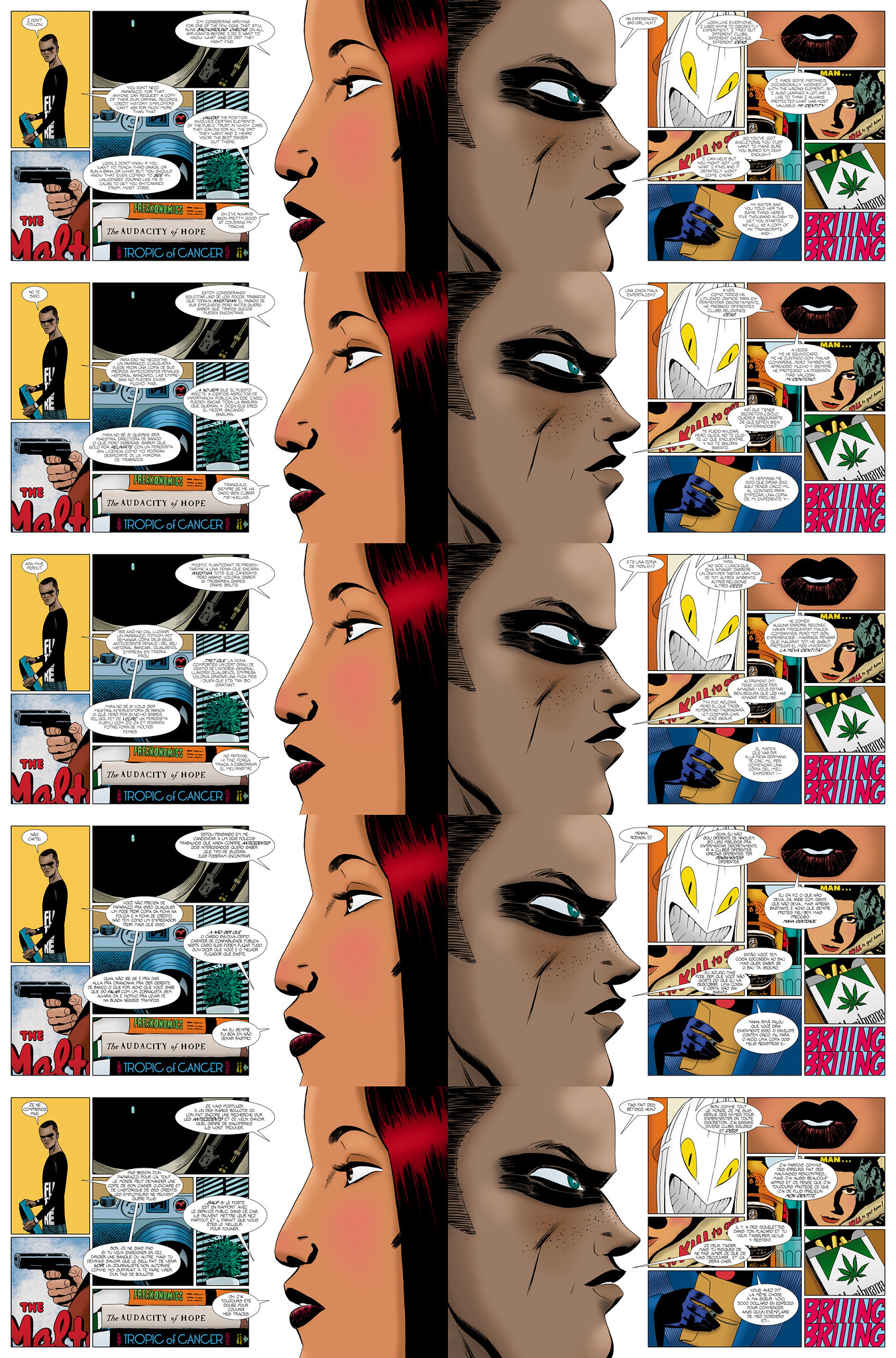
Private Eye #1, Pages 19 & 20, by Brian K. Vaughan & Marcos Martin (Panel Syndicate, 2013)
Languages (top to bottom): English, Spanish, Catalan, Portuguese, French
(Open the image in a new tab or click here for bigger.)
The idea to release The Private Eye online, DRM-Free and Pay-What-You-Want, was Marcos Martin's. He'd been looking to do something like that for some time and the opportunity that presented itself in Brian K. Vaughan's story was too good to pass up (especially in light of the storyline parallels about a specifically analog future without an internet). But Martin's true stroke of genius with The Private Eye's release format is in the multiple languages in which every issue has been and will be released.

Martin is a Spanish artist fluent in Spanish, English and Catalan, a romance language spoken in Southern Spain, France and Andorra. When Martin and Vaughan set up their novel distribution method, it was a small step for Martin to release the material in the three languages he was familiar with. And as each issue was released, additional languages would be added on, to date Portuguese and French with more in the pipeline. The nature of the work's production and release, both purely digital, makes this possible.

In most cases of translations of North American mainstream comics, there is a significant time and logistics lag involved. You first must find a publisher for the work in each market, dealing with the logistics of royalties and copyright. In many cases, even popular works by known creators may not see publication in foreign markets for years after initial North American publication, if at all. The availability in each market may be completely outside the creators' hands, with some publishers licensing out work without contractual obligation to pay royalties or even inform the creators involved. And this works both ways, with many well-received European (especially French and Italian) or Japanese comics never matriculating their way Stateside.

In The Private Eye's case, the work has already been released to every market on the globe with a computer attached, and it is a very simple matter to upload versions released under increasingly diverse languages. There are no printing costs involved and the only limit is the creators' will and the availability of quality translations. By their liberal and aggressive internationalization of The Private Eye coupled with their easy to access DRM-Free PWYW model, not only are Vaughan and Martin able to get access to the vibrant comic markets in North America, Spain, Italy, France and the United Kingdom, but they also have an immediate global reach not limited to countries with a comic tradition, a reach achieved by few creators in the history of comics. In the five languages The Private Eye has been released under so far, they can reach 1.2 billion potential native speakers (not even counting non-native speakers). Naturally the potential audience is much smaller than that, limited by access and desire as is any potential audience, but for the first time Vaughan and Martin have in an instant global audience. And by putting out the translations themselves as soon as possible, they negate the need for "scanlations" (fan translated digital bootlegs) ensuring quality control and added potential financial return.

It is this globalization of the type of quality material originally limited to North America that will change comics forever. The power of the tools Vaughan and Martin have at their disposal, coupled with their vision and will to utilize those tools, are truly remarkable.

Already the industry is shifting in response to Vaughan and Martin's vision: Image has announced that their titles will be DRM-Free, though not Pay-What-You-Want. But some established Image books, as well as every comic and graphic novel put out by America's largest publishers Marvel and DC, are locked into long-term republication and licensing contracts that necessitate large gaps in time and catalog coverage between different languages and regions. But it is a given that more creators with control over their rights to their work - a steadily increasing proportion in the light of the creator-owned renaissance gleefully endemic of this decade - will begin to internationalize their works like Vaughan and Martin have with The Private Eye, especially if they have digital global distribution at their disposal, even DRM limited distribution which most North American comics fall under.  


And of course, the comics medium exists as a unique visual language all its own where there is no translation necessary. But the costs of translation are minimal and the benefits are nearly endless. The Private Eye is the perfect work, with its quality and accessibility, to lead the vanguard of the new future of comics as a truly global phenomenon.

--
The Private Eye by Brian K. Vaughan and Marcos Martin is published monthly, DRM-Free and Pay-What-You-Wish in multiple languages by The Panel Syndicate at www.panelsyndicate.com

Wednesday, March 20, 2013

Quick Hits: Six New Comics for March 20 including Ultimate Spider-Man, The Private Eye, BPRD and More


In this week's Wednesday Review, I review Brian Michael Bendis and Jonathan Hickman's latest Marvel superhero offerings, Brian K. Vaughan and Marcos Martin's revolutionary The Private Eye, BPRD and more.

Ultimate Spider-Man (issue 21 out today) may very well be my favorite purely superhero superhero comic, if that makes any sense. There is nothing more complicated than superheroics going on, not that superheroics are simple for young Miles Morales. Miles, the best new character in comics, is still coming to terms with his powers and all the responsibility and risk to himself and his friends and family this means. His father is in the hospital, a victim of Peter Parker's old enemy Venom, a case of mistaken identity. For not-all-that complicated reasons, Venom thinks his dad is the new Spider-Man. Miles feels that he and his power set are responsible for his family's situation, and in many ways he is and in many ways it was an unavoidable aspect of what it means to be a superpowered human. The path forward is fraught: in an America fractured by catastrophic war and political strife, how does he confront the menace that Venom represents while protecting his family? And how does he protect his identity when the government knows who he is and the police are sniffing around his door? He's not alone in his drama, and people from the martyred Peter Parker's past come into Miles' life to aid him in his struggle. The formula that made the original Steve Ditko/Stan Lee Amazing Spider-Man works so purely timeless and remarkable - young man in over his head just trying to live his life and do right by his values and be there for his family, filled with drama and humor -  is perfectly encapsulated in Ultimate Spider-Man. The dialogue and personal encounters are presented effortlessly, the plotting logical and tight. Brian Bendis is home with this setting, this universe, these characters. His scripting is simply flawless, and he - and we - are spoiled by the artistic talents of Sarah Pichelli. Her increasingly assured art - seamlessly alternating between angular Spidey-in-fight (although Miles does not appear in costume in this issue) to the nightmare monstrosity of Venom on through to extended sequences of people, wonderfully acted, simply talking - is frankly exhilarating. Where everything that is bad and wrong and ugly with superhero comics is represented in Bendis's truly abysmal Age of Ultron, everything that is fun and stirring and electric about superhero comics, the potentiality of the form in all it's wonder, can be found in Ultimate Spider-Man.

The stakes for Miles in Ultimate Spider-Man are more personal, singular, where the stakes in Jonathan Hickman's Avengers work are global, universal, multiversal. A superb example of decidedly epic superhero sci-fi storytelling in the long-form can be found in this week's New Avengers 4 and Avengers 8 both written by Jonathan Hickman. In Avengers we get the fiery birth (more accurately violent intrusion) of the New Universe in the Marvel Universe. A new Star-Brand, a world-protector, has been forged in the form of a young unassuming college student, at the cost of thousands of lives. The Avengers, expanding their ranks to include many of the Marvel Universe's heaviest heavy hitters comes to the scene to retrieve the Star-Brand and control the potential outcome. But vast new power comes with fear and uncertainty. Hickman's S.H.I.E.L.D. collaborator, Dustin Weaver turns in an issue of the wonderfully detailed and well-drafted art we have come to expect from him. In the more insular but no less epic New Avengers, the new Illuminati continue to dig the trench deeper as the dark cost of their actions begins to effect them. Nothing short of the Universe is at stake and they are willing to sacrifice an entire Earth to spare their own. But despite their own willingness to do the unthinkable, there morality prevents them from inaction when inaction would achieve their goals. This is a book of big ideas, from Dyson Spheres to Galactus and the anti-matter kitchen sink thrown in. Steve Epting's art here is some of his best, on Earth and an Earth and space, in heated conversation and a perfectly executed display of powers at odds. Everything that is and can be is at stake and the outcome is far from certain.

Moving on to my other favorite vividly realized shared universe in comics, Mike Mignola and John Arcudi's B.P.R.D. 105 continues to use the foundation of years of great storytelling and fun and unique concepts that make the Mignola-verse so continuously fresh and exciting. The Earth is a dark mirror of the one we know, with humanity in a state of constant war against interdimensional monsters who have overrun the entire globe. This is an international fight with borders being meaningless lines on a map. Splitting our time between the Bureau for Paranormal Research and Defense headquarters & the unexpected awakening of a key player, and the brutal environs of Siberia, the first part of "A Cold Day In Hell" effortlessly utilizes the rich setting and history and - always a dangerous concept - continuity that we've come to expect from the Hellboy/BPRD Universe. Where the various BPRD books have been hit-or-miss of late, this issue hits solidly on the sweet spot, the dark vision of a screwed world of monsters and menace wonderfully realized by Peter Snejbjerg and on art duties. Indeed Snejbjerg is probably the best artist to tackle BPRD-proper since Guy Davis left the book last year, and I look forward to a lot more from him here.

The world of comics was rocked this week (in a good way) by the literally unheralded release of the new Brian K. Vaughan/Marcos Martin comic The Private Eye. One could write volumes on the about the release, online under a frankly revolutionary DRM-free pay-as-you-please model in multiple languages. There have been webcomics for ages and all kinds of different models for payment, but nothing quite like this from two bona-fide A-listers on the cutting edge of their creative game. A widescreen 32 page comic, the story and high-concept - 70 years hence in a world of disguise and obfuscation where the press have a unique power and standing in a radically different internet-abolished society - and art, in all its technicolor futureshock glory just leap off the screen. That they are releasing it in the format that they are is a big factor in what will put this on the map, but if the story and art weren't there in quality the experiment would be a failure. Thankfully Vaughan and Martin are unimpeachably amazing and they execute what would be an assured head-turning best-seller in any traditional model. When so many comics are 20 pages of mediocre pap for four dollars, you can get 32 pages of amazing comic storytelling for whatever you want to pay, and where all the money goes to the creators. Try it for free then double back and pay for the value of pure story you receive, a high value indeed.

Private Eye and Saga from Vaughan and MIND MGMT from Matt Kindt came out this week, all superb examples of the true vanguard of the creator-owned renaissance. But all is not good in creator-owned land: last week saw thew release of a truly dreadful piece of nonsense in Justin Gray and Jimmy Palmiotti's Trigger Girl 6. Serialized in their mercifully canceled Creator Owned Heores anthology, I picked this up based on Phil Noto's artistic contributions. Though credited on the cover as almost an afterthought, his art here is just fine. It's the ham-fisted, downright stupid story from Palmiotti and Grey that makes this so awful. It starts out strong, with a futuristic superassassin targeting the President. Then the plot happens. It's a pretty bad when, even in a genre and medium accustomed to ridiculousness, that I can't accept (or even want to remotely explain) the gibberish that ensues. Just take the $5.99 that you thought you might want to spend on this and put it towards The Private Eye.

Private Eye is currently available for download at http://panelsyndicate.com/ This week's comics provided by Jim Hanley's Universe, New York City's premier comic book store, Where Art and Literature Meet.