Showing posts with label marcos martin. Show all posts

Friday, July 12, 2013

The International Private Eye and The Future of Comics

How the Internationalization of Brian K. Vaughan & Marcos Martin's The Private Eye Will Change Comics

Much is being written, and deservedly so, about Brain K. Vaughan and Marcos Martin's The Private Eye. Self-published online through their Panel Syndicate venture, the monthly comic is being hailed as fairly revolutionary for their publishing model: DRM-Free and Pay-What-You-Want.

Artists releasing material and letting the audience dictate its value is not new, but still a bit of a novelty, especially in comics. If there had been instances in the past of comic PWYW releases, they never made an impact the way that The Private Eye has. The Private Eye is just like Radiohead's In Rainbows, a highly anticipated Pay-What-You-Want release from A-List creators with top-flight production values and undeniable critical success and fan response. While there was much supposition on its release that In Rainbows would change the music industry with many more PWYW releases, this hasn't been the case. Monetized digital downloads of music has revolutionized the record industry, but that was going to happen regardless. The mainstream comic industry finds itself on a similar digital precipice and has been smartly taking advantage of it through various DRM means (Digital Rights Management, that is releasing material tied to a specific program or device). But DRM-Free releases online of comics are actually nothing new - simply look at pretty much every webcomic ever made. But unlike most webcomics, the release format of The Private Eye - ten issue monthly maxi-series of 22-30 page comics with cover and backmatter - is more like mainstream North American comic releases, which are almost never released DRM-Free. And unlike most webcomics, The Private Eye is being produced by two very well-known, critically acclaimed creators who can arguably write their own ticket with any mainstream creator-owned publisher. For Brian K. Vaughan and Marcos Martin to release The Private Eye the way they have is risky, far more so than if they were releasing it through any traditional creator-owned publishing outlet. But it appears the risk is paying off for the creators.

This is all noteworthy, but at the end of the day the experiment would be a failure if the finished product was no good. Unsurprisingly for two creators with their proven creative track-record, Vaughan & Martin's The Private Eye is a superb comic, a complex visual feast wrapped in a layered sci-fi noir parable. Vaughan's story, a richly detailed metaphor about privacy and the media, follows a private investigator in over his head in a murder plot in a future where privacy was apocalyptically shattered and everyone hides behind a mask. Martin's art - with Muntsa Vicente's extraordinary colors - reveals a master storyteller at work, explosive action and dramatic character set-pieces bouncing through an astonishingly realized futurescape. Three issues have been released so far, all of them riveting.

But as good as the comic is, as unique the release format is, I think the most important aspect of the story's release that may have a larger historical impact than anything else the two creators are doing, is the aggressive internationalization of the work.
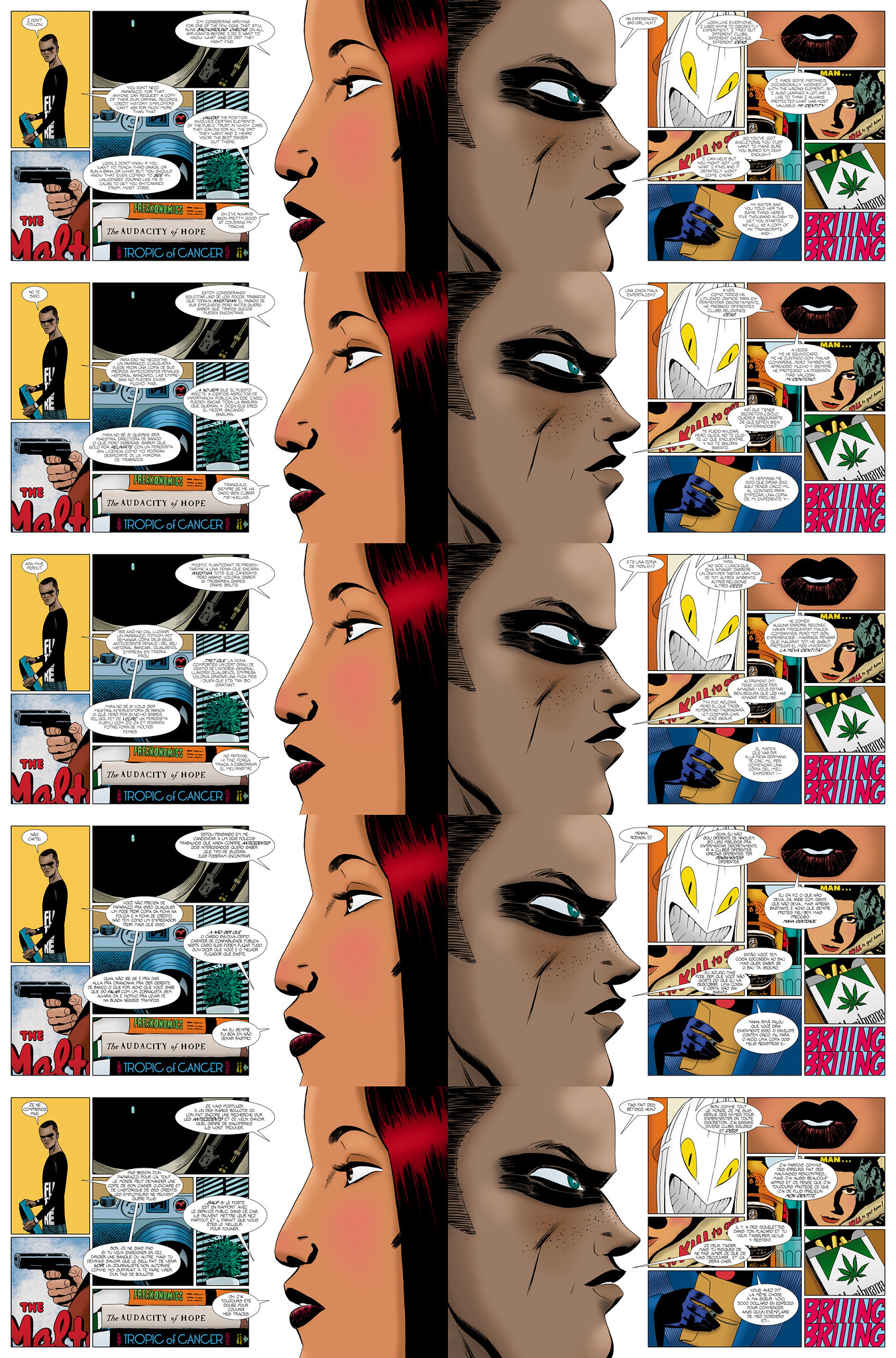
Private Eye #1, Pages 19 & 20, by Brian K. Vaughan & Marcos Martin (Panel Syndicate, 2013)
Languages (top to bottom): English, Spanish, Catalan, Portuguese, French
(Open the image in a new tab or click here for bigger.)
The idea to release The Private Eye online, DRM-Free and Pay-What-You-Want, was Marcos Martin's. He'd been looking to do something like that for some time and the opportunity that presented itself in Brian K. Vaughan's story was too good to pass up (especially in light of the storyline parallels about a specifically analog future without an internet). But Martin's true stroke of genius with The Private Eye's release format is in the multiple languages in which every issue has been and will be released.

Martin is a Spanish artist fluent in Spanish, English and Catalan, a romance language spoken in Southern Spain, France and Andorra. When Martin and Vaughan set up their novel distribution method, it was a small step for Martin to release the material in the three languages he was familiar with. And as each issue was released, additional languages would be added on, to date Portuguese and French with more in the pipeline. The nature of the work's production and release, both purely digital, makes this possible.

In most cases of translations of North American mainstream comics, there is a significant time and logistics lag involved. You first must find a publisher for the work in each market, dealing with the logistics of royalties and copyright. In many cases, even popular works by known creators may not see publication in foreign markets for years after initial North American publication, if at all. The availability in each market may be completely outside the creators' hands, with some publishers licensing out work without contractual obligation to pay royalties or even inform the creators involved. And this works both ways, with many well-received European (especially French and Italian) or Japanese comics never matriculating their way Stateside.

In The Private Eye's case, the work has already been released to every market on the globe with a computer attached, and it is a very simple matter to upload versions released under increasingly diverse languages. There are no printing costs involved and the only limit is the creators' will and the availability of quality translations. By their liberal and aggressive internationalization of The Private Eye coupled with their easy to access DRM-Free PWYW model, not only are Vaughan and Martin able to get access to the vibrant comic markets in North America, Spain, Italy, France and the United Kingdom, but they also have an immediate global reach not limited to countries with a comic tradition, a reach achieved by few creators in the history of comics. In the five languages The Private Eye has been released under so far, they can reach 1.2 billion potential native speakers (not even counting non-native speakers). Naturally the potential audience is much smaller than that, limited by access and desire as is any potential audience, but for the first time Vaughan and Martin have in an instant global audience. And by putting out the translations themselves as soon as possible, they negate the need for "scanlations" (fan translated digital bootlegs) ensuring quality control and added potential financial return.

It is this globalization of the type of quality material originally limited to North America that will change comics forever. The power of the tools Vaughan and Martin have at their disposal, coupled with their vision and will to utilize those tools, are truly remarkable.

Already the industry is shifting in response to Vaughan and Martin's vision: Image has announced that their titles will be DRM-Free, though not Pay-What-You-Want. But some established Image books, as well as every comic and graphic novel put out by America's largest publishers Marvel and DC, are locked into long-term republication and licensing contracts that necessitate large gaps in time and catalog coverage between different languages and regions. But it is a given that more creators with control over their rights to their work - a steadily increasing proportion in the light of the creator-owned renaissance gleefully endemic of this decade - will begin to internationalize their works like Vaughan and Martin have with The Private Eye, especially if they have digital global distribution at their disposal, even DRM limited distribution which most North American comics fall under.  


And of course, the comics medium exists as a unique visual language all its own where there is no translation necessary. But the costs of translation are minimal and the benefits are nearly endless. The Private Eye is the perfect work, with its quality and accessibility, to lead the vanguard of the new future of comics as a truly global phenomenon.

--
The Private Eye by Brian K. Vaughan and Marcos Martin is published monthly, DRM-Free and Pay-What-You-Wish in multiple languages by The Panel Syndicate at www.panelsyndicate.com

Monday, June 24, 2013

Batgirl, Robin and Marcos Martin: Year One

Batgirl/Robin: Year One
By Beatty, Dixon, Martin and Pulido
DC Comics, 2001,2003, 2013
As I've noted elsewhere, I'm an avowed Marvel guy. Though I do read a few ongoing DC superhero books, and am certainly well-versed in the definitive works, there are very large gaps in my DC knowledge. For instance, I know precious little about Robin, the Batman sidekick. What I do know is that there has been a bunch of them, and that people have passionate opinions about each and every one. The first Robin, Dick Grayson, was introduced into the Batman comics of the 1940s largely to attract a younger audience, and to say that ploy was successful is a massive understatement. Grayson would be Robin for 40 years before becoming Nightwing, and nearly every adaptation of Batman produced since features Dick Grayson as the character. Subsequent Robins would each develop new identities, die, or both, but it is Dick Grayson that is arguably the best known of the characters to inhabit the role of Robin.

Another of Batman's many associates over the decades is the seemingly derivative Batgirl, another character with many different individuals under the cowl. While not the first woman to take on the Batgirl identity, the longest serving and best known is Barbara Gordon, daughter of Jim Gordon and ultimately one of superhero comics' most tragic figures. But long before her victimization at the hands of the Joker (and Alan Moore), Barbara Gordon for many was - and still is - the definitive Batgirl.

For years many publishers, but especially DC, have produced many "Year One" miniseries which retell the origin of a particular character. Most of these try to follow the mold set by Frank Miller and the incomparable David Mazzucchelli in their collaborative masterwork Batman: Year One. This week DC released a massive softcover collection combining two such outings, Batgirl/Robin: Year One, focusing on Gordon and Grayson. The incredible value presented - over 425 pages for less than twenty-five dollars - is worth checking the volume out. But the real reason to take this home comes down to the artists involved, Marcos Martin and Javier Pulido.

I've written about my love of both artists' works, especially Pulido's very recent star turn on Shade and Hawkeye and Martin's consistent mastery on Daredevil and Private Eye, so I came to the stories presented here with great interest in the visuals if less the actual characters. It certainly helps that the stories, companion pieces both written by the team of Scott Beatty & Chuck Dixon, do a very competent job of presenting the characters' individual early development and capturing the essence of who they are as people. Those already familiar with the characters are also likely already familiar with the stories presented in this collection, but for a novice like myself, I came to a better appreciation of the who and why of the people under the masks, despite my own misgivings about the larger questions of the morality involved.

Now the morality of which I speak is in my... objections, I guess you can call it, to Robin's presence in the Bat-mythos, whoever that Robin may be. I've long been bothered by the simple impropriety of the thing. There are many moral questions raised by the nature of masked vigilantism, certainly most existing in a murky grey area, but I've long believed that Bruce Wayne's allowance - if not outright exploitation - of children acting alongside him is unambiguously wrong. This isn't a type of irrational Werthamesque argument but an acknowledgement that the Robins are not much more than child soldiers, with all the moral disgust such a thought rightly evokes. The child sidekick, just one of many bizarre aspects of superhero comics - that bizarre and uniquely American genre - bothers me, and is one of many factors that make it hard for me to get into DC superhero comics.

To Robin: Year One's credit, I am not the only one bothered by Robin's presence alongside Batman. Rather than telling Dick Grayson's story entirely from his perspective, most of the series' narration comes from Alfred Pennyworth, butler-father to Bruce Wayne and aide-de-camp to Batman, who is deeply troubled by Grayson being Robin. To be certain, Alfred vacillates between indignation, uncertainty, and begrudging acceptance, and he is ultimately just as culpable as Bruce Wayne in the end. But his narration, sardonic yet heartfelt, and his constant role as Batman's moral center wonderfully grounds the book. The graphic novel is really four connected novellas, not specifically telling his well-known origin as much as establishing the full year of Robin's development as promised by the title. The villains in each story, players from Batman's rogues gallery like the Mad Hatter, Mr. Freeze, Two-Face and the like, aren't all that interesting (they rarely are). What is interesting is Dick Grayson as a character. You get the sense that Grayson is Robin no matter what Wayne and Pennyworth want. After being brutally beaten nearly to death, he is slowly nursed back into health and continues vigilantism over Batman's wishes. Batman objects to Robin's continued war on crime, but this was a war that Batman started, that Batman recruited Robin into. Despite Grayson's iron will to act despite what anyone thinks, despite their similarity in motivation (parents lost to crime), Bruce Wayne put him into that position. Towards the end, Grayson strikes out on his own to infiltrate a shady group of skilled criminals, foreshadowing his own development into Nightwing. And in the end Batman takes him back into the fold. "You really want me to be Robin again?" "I want you to be a good soldier." Alfred insists that he could walk away, spend his life in happier pursuits. Be a kid. Many times we are shown Grayson sacrificing the small pleasures of adolescence to partake in Bruce Wayne's quixotic crusade. And in the end, to Alfred's heartache, Grayson chooses Robin. Certainly Grayson wants to be Robin badly, and takes great joy from it. His reascension to Batman's side is seen as a victory for him. But is is also one of the small tragedies of his character, a childhood lost.

Batgirl: Year One is a distinctly different work in tone and accomplishment. Barbara Gordon's development into Batgirl is not one of apprenticeship but of fierce independence. Unlike Grayson, she was an adult when she took up the cowl, partially inspired by the Batman. Barbara Gordon is the daughter of soon-to-be Gotham Police Chief Jim Gordon. She wants to be a cop like her dad, not just some computer whiz clerk at a library. But Jim Gordon doesn't want his little girl anywhere near a police uniform. Coupled with her father's objections and her own slight physical stature, she is repeatedly rejected in her attempts to enter law enforcement. But Barbara Gordon is a master of Jujitsu and an even more masterful hacker, and finds a way to break into Justice Society headquarters to get attention of at least some of the powers that be, to try to serve her city in any way she can. Rejected by the JSA, she strikes out on her own, copying the M.O. of so many of the so-called superheroes popping up in Batman's shadow. "Is this how they do it?" she asks as she creates her costume, her very identity. "Masked vigilantes... One stitch at a time, until the costume makes your future?" Batgirl: Year One provides a fascinating look at one woman's quest to become a vigilante at the dawn of the new wave of vigilantism. The slow and methodical development of her physical and technological skill set, and the fiery nature of her very being as realized by Marcos Martin is wonderful to behold. She eventually draws the attention of some z-list villain called the Killer Moth and his not-quite sane partner Firefly. She also draws the attention of Batman and Robin, wondering who this girl is and why she is doing what she's doing. Again the bits of plot about the villains aren't nearly as interesting as the parts focusing on Barbara Gordon herself. She is an inspiring and frankly wonderful character, and whatever her fate may hold, whatever hamfisted foreshadowing of fridge-stuffing by the writers, Year One is an entertaining read.

But back to my reason for reading these stories in the first place. While the characters at first didn't interest me (though did eventually win me over), I came into this for artists Javier Pulido and Marcos Martin. Both comics represent the earliest mainstream work from both artists; Robin came out in 2000 and 2001, Batgirl in 2003. Pulido and Martin have a very similar style, and they work in tandem on Robin: Year One. While their styles are distinct enough to the trained eye, the early nature of the work and Robert Campanella's unifying inks blend the two together seamlessly. While you get many hints of the distinction in style both artists would develop, as a finished piece it's not quite to the creative level both would later establish. Nevertheless, the art mercifully carries the story. But it's Martin's solo work on the Batgirl story that shows his true brilliance. Definitively, Marcos Martin on Batgirl: Year One announces his status as one of the best and most unique visual creative mainstream voices of the last decade.

In Batgirl: Year One, Martin shows a mastery of perspective and physicality that takes your breath away. Martin repeatedly breaks free from rote settings, staging scenes with an eye-popping clarity and energy. The physical presence of his characters on the page is a wonder to behold, as far as possible from the superhero 101 of bulging everything. And the pure physicality of the character's actions captures the brutal nature of the violent world of capes and thugs with a rarely felt immediacy. When a punch happens, it is with the force and sudden room-stopping violence of the real damn thing. Barbara Gordon may be too short to join the GCPD but she can improvisationally and acrobatically take down three gunmen in a tight setting with brutality and elegance. Every action panel is clear and effective, like the best directed action movie fight never made. And Martin's skill isn't limited to back alley fights and chases in the night, but oozes out of every page, from heated conversations to quiet scenes. His framing of every single panel is done with thoughtfulness and an inspiring joie de vivre. The way he frames a wry smile, or determined eyes, says volumes in a tiny space. The cartooniness of his figures and faces draw you in, and his ability to make the characters subtly emote connects you to them even further. Marcos Martin possesses and shows here a Frank Quitely ability to translate body language with modern-day David Aja slash J.H. Williams III flash and Darwynn Cooke accessibility, all greater than the sum of its parts, all completely, purely Marcos Martin. In Batgirl: Year One we get Marcos Martin: Year One, as he expertly hones the skills that would give us the Full Ditko of Dr. Strange and The Amazing Spider-Man and the superstylized senses-shock of Daredevil and The Private Eye. Alvaro Lopez on inks and Javier Rodriguez on colors help bring it all home. No offense to all the other creators involved here but this is about Marcos Martin and the foundation of a visual superstar in the making.

Whatever narrative weaknesses in both stories are more than made up for in the superb quality of the art. And despite whatever recent editorial clusterfuckery that negates the canonicity of the works, these are fun character stories about the place of vigilantism and the type of people who engage in it. Superheroes are a weird and wonderful thing, so much more wonderful in the capable hands of the likes of Pulido and Martin.

Buy Batgirl/Robin: Year One on Amazon here.

Wednesday, March 20, 2013

Quick Hits: Six New Comics for March 20 including Ultimate Spider-Man, The Private Eye, BPRD and More


In this week's Wednesday Review, I review Brian Michael Bendis and Jonathan Hickman's latest Marvel superhero offerings, Brian K. Vaughan and Marcos Martin's revolutionary The Private Eye, BPRD and more.

Ultimate Spider-Man (issue 21 out today) may very well be my favorite purely superhero superhero comic, if that makes any sense. There is nothing more complicated than superheroics going on, not that superheroics are simple for young Miles Morales. Miles, the best new character in comics, is still coming to terms with his powers and all the responsibility and risk to himself and his friends and family this means. His father is in the hospital, a victim of Peter Parker's old enemy Venom, a case of mistaken identity. For not-all-that complicated reasons, Venom thinks his dad is the new Spider-Man. Miles feels that he and his power set are responsible for his family's situation, and in many ways he is and in many ways it was an unavoidable aspect of what it means to be a superpowered human. The path forward is fraught: in an America fractured by catastrophic war and political strife, how does he confront the menace that Venom represents while protecting his family? And how does he protect his identity when the government knows who he is and the police are sniffing around his door? He's not alone in his drama, and people from the martyred Peter Parker's past come into Miles' life to aid him in his struggle. The formula that made the original Steve Ditko/Stan Lee Amazing Spider-Man works so purely timeless and remarkable - young man in over his head just trying to live his life and do right by his values and be there for his family, filled with drama and humor -  is perfectly encapsulated in Ultimate Spider-Man. The dialogue and personal encounters are presented effortlessly, the plotting logical and tight. Brian Bendis is home with this setting, this universe, these characters. His scripting is simply flawless, and he - and we - are spoiled by the artistic talents of Sarah Pichelli. Her increasingly assured art - seamlessly alternating between angular Spidey-in-fight (although Miles does not appear in costume in this issue) to the nightmare monstrosity of Venom on through to extended sequences of people, wonderfully acted, simply talking - is frankly exhilarating. Where everything that is bad and wrong and ugly with superhero comics is represented in Bendis's truly abysmal Age of Ultron, everything that is fun and stirring and electric about superhero comics, the potentiality of the form in all it's wonder, can be found in Ultimate Spider-Man.

The stakes for Miles in Ultimate Spider-Man are more personal, singular, where the stakes in Jonathan Hickman's Avengers work are global, universal, multiversal. A superb example of decidedly epic superhero sci-fi storytelling in the long-form can be found in this week's New Avengers 4 and Avengers 8 both written by Jonathan Hickman. In Avengers we get the fiery birth (more accurately violent intrusion) of the New Universe in the Marvel Universe. A new Star-Brand, a world-protector, has been forged in the form of a young unassuming college student, at the cost of thousands of lives. The Avengers, expanding their ranks to include many of the Marvel Universe's heaviest heavy hitters comes to the scene to retrieve the Star-Brand and control the potential outcome. But vast new power comes with fear and uncertainty. Hickman's S.H.I.E.L.D. collaborator, Dustin Weaver turns in an issue of the wonderfully detailed and well-drafted art we have come to expect from him. In the more insular but no less epic New Avengers, the new Illuminati continue to dig the trench deeper as the dark cost of their actions begins to effect them. Nothing short of the Universe is at stake and they are willing to sacrifice an entire Earth to spare their own. But despite their own willingness to do the unthinkable, there morality prevents them from inaction when inaction would achieve their goals. This is a book of big ideas, from Dyson Spheres to Galactus and the anti-matter kitchen sink thrown in. Steve Epting's art here is some of his best, on Earth and an Earth and space, in heated conversation and a perfectly executed display of powers at odds. Everything that is and can be is at stake and the outcome is far from certain.

Moving on to my other favorite vividly realized shared universe in comics, Mike Mignola and John Arcudi's B.P.R.D. 105 continues to use the foundation of years of great storytelling and fun and unique concepts that make the Mignola-verse so continuously fresh and exciting. The Earth is a dark mirror of the one we know, with humanity in a state of constant war against interdimensional monsters who have overrun the entire globe. This is an international fight with borders being meaningless lines on a map. Splitting our time between the Bureau for Paranormal Research and Defense headquarters & the unexpected awakening of a key player, and the brutal environs of Siberia, the first part of "A Cold Day In Hell" effortlessly utilizes the rich setting and history and - always a dangerous concept - continuity that we've come to expect from the Hellboy/BPRD Universe. Where the various BPRD books have been hit-or-miss of late, this issue hits solidly on the sweet spot, the dark vision of a screwed world of monsters and menace wonderfully realized by Peter Snejbjerg and on art duties. Indeed Snejbjerg is probably the best artist to tackle BPRD-proper since Guy Davis left the book last year, and I look forward to a lot more from him here.

The world of comics was rocked this week (in a good way) by the literally unheralded release of the new Brian K. Vaughan/Marcos Martin comic The Private Eye. One could write volumes on the about the release, online under a frankly revolutionary DRM-free pay-as-you-please model in multiple languages. There have been webcomics for ages and all kinds of different models for payment, but nothing quite like this from two bona-fide A-listers on the cutting edge of their creative game. A widescreen 32 page comic, the story and high-concept - 70 years hence in a world of disguise and obfuscation where the press have a unique power and standing in a radically different internet-abolished society - and art, in all its technicolor futureshock glory just leap off the screen. That they are releasing it in the format that they are is a big factor in what will put this on the map, but if the story and art weren't there in quality the experiment would be a failure. Thankfully Vaughan and Martin are unimpeachably amazing and they execute what would be an assured head-turning best-seller in any traditional model. When so many comics are 20 pages of mediocre pap for four dollars, you can get 32 pages of amazing comic storytelling for whatever you want to pay, and where all the money goes to the creators. Try it for free then double back and pay for the value of pure story you receive, a high value indeed.

Private Eye and Saga from Vaughan and MIND MGMT from Matt Kindt came out this week, all superb examples of the true vanguard of the creator-owned renaissance. But all is not good in creator-owned land: last week saw thew release of a truly dreadful piece of nonsense in Justin Gray and Jimmy Palmiotti's Trigger Girl 6. Serialized in their mercifully canceled Creator Owned Heores anthology, I picked this up based on Phil Noto's artistic contributions. Though credited on the cover as almost an afterthought, his art here is just fine. It's the ham-fisted, downright stupid story from Palmiotti and Grey that makes this so awful. It starts out strong, with a futuristic superassassin targeting the President. Then the plot happens. It's a pretty bad when, even in a genre and medium accustomed to ridiculousness, that I can't accept (or even want to remotely explain) the gibberish that ensues. Just take the $5.99 that you thought you might want to spend on this and put it towards The Private Eye.

Private Eye is currently available for download at http://panelsyndicate.com/ This week's comics provided by Jim Hanley's Universe, New York City's premier comic book store, Where Art and Literature Meet.