Showing posts with label book reviews. Show all posts

Wednesday, September 4, 2013

The Wednesday Review: Rebutting Alan Moore (or, Infinite X in 3D)


Last week, the third issue of Black Mask's crowdfunded benefit anthology, Occupy Comics came out. The comics haven't really been the main event in OC for me as much as Alan Moore's stunning serialized essay on the history of comics, Buster Brown at the Barricades. As good a concise (if hardly neutral) history of comics you will ever read, Moore packs in an extraordinary amount of vividly portrayed historical context into each dense, fiery installment. The final chapters of his essay (written last summer) finally saw print in Occupy 3 and covered the underground comix counterculture of the 1960s all the way through to the present day comic scene. All told, Buster Brown is a fascinating, illuminating and flawed history/opinion of comics told by one of the medium's finest creators.
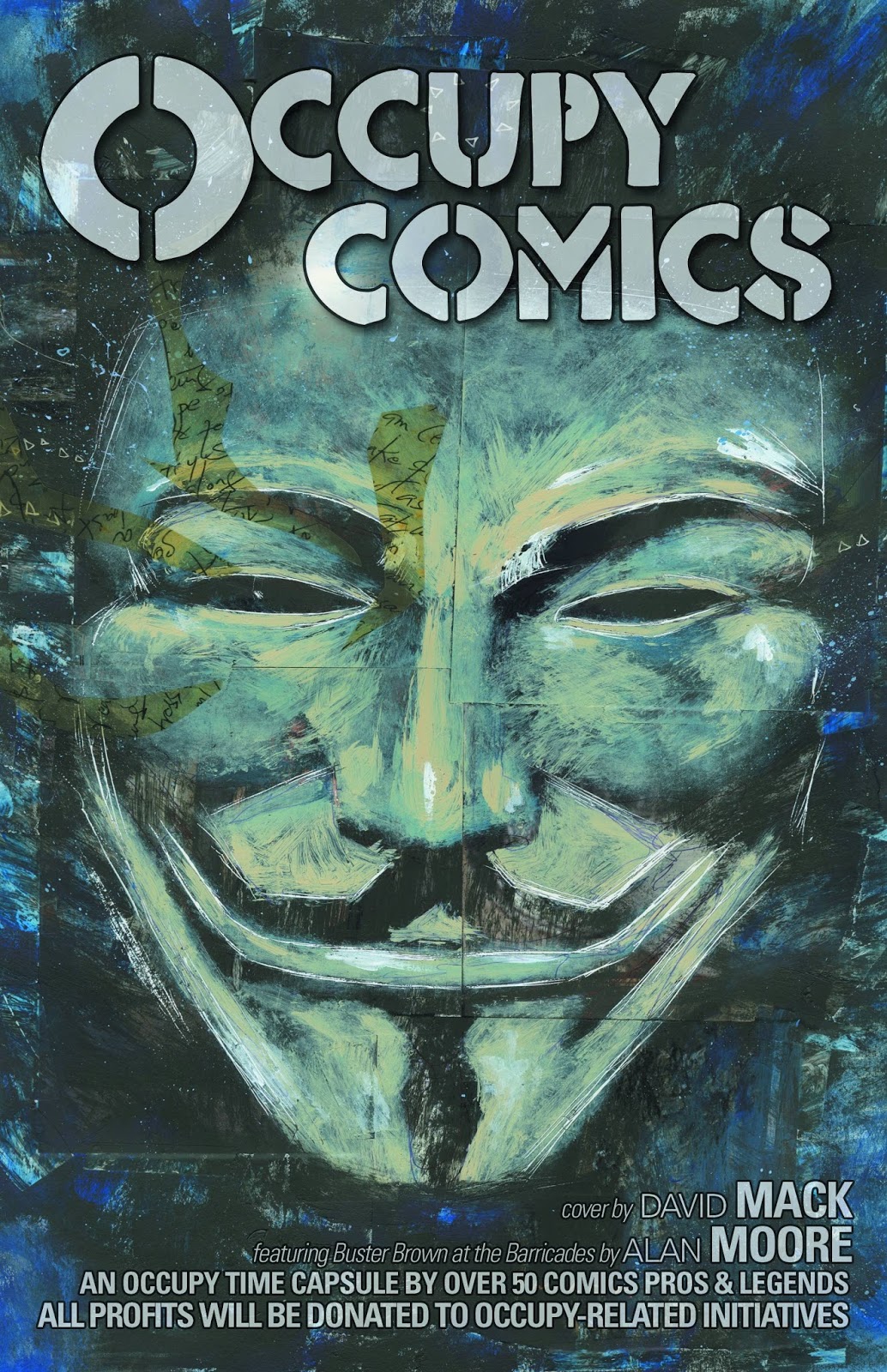
Buster Brown at the Barricades by Alan Moore,
to be collected in Occupy Comics TPB in Nov.
But I've been critical of Moore's statements about modern comics in the past and he certainly offers up much to be critical of here. To be fair, the depth of his prose here gives a more nuanced view of his opinion about modern comics mitigating some of my past frustrations. In a nutshell, Moore has made statements in the past noting, conversely, that he doesn't read modern comics and that all modern comics are derivative shit. That's a bit of a simplification, but I do believe that's the gist, and you can see the problem: that's like me saying "I never listen to opera, all opera is shit." When Moore lumps all of modern comic storytelling together into one group he admits to being unfamiliar with, it does his argument absolutely no favors. But as I said, in Buster Brown he puts his argument forth in a bit more detail.

Most of his essay is solidly mixed with righteous anger over treatment of creators past and present, logical and defensible frustrations with mainstream quality, and a large amount of outright bitterness. He rails against mainstream comics as universally moribund and quality-free. But his passionate rejection of anything remotely mainstream finds him wildly missing the mark in several places. He notes the cutting edge work of Neil Gaiman, Warren Ellis, and Garth Ennis, stating that all three would go on to "relocate to an area of the comics landscape that was as far distant from the mainstream as possible." Which is of course gibberish: all three continue to work solidly within the mainstream American comic market, with all three working for Marvel this year alone. He focuses, appropritately, on both the creative and aesthetic harm Image comics caused the industry during the speculator bubble of the 1990s, only briefly mentioning the company's current "progresive and creator-friendly" place in the market. This is an underestimation and understatement of the company's vital role in a stunning renaissance of critically acclaimed, best-selling, entertaining and high quality creator-owned material being published now.

Moore's narrow view that there is absolutely nothing good in the mainstream wasteland is, of course, spurious bullshit. In Donna Bowman's remarkable series of essays on Breaking Bad for The AV Club, she outlines a similar corollary in television that I think deserves full quoting:
It's easy to look at television, with its 500 channels worth of endless crappy versions of the same empty ideas, and conclude that everything's gone to shit ... [proclaiming] the dreary, inevitable decline of entertainment, and answer my protests to the contrary with assertions that searching for the few worthwhile nuggets in that morass is a pointless waste of their time. Ironically, this pronouncement coincides with the greatest flowering of televised drama and comedy in the medium's history ... the best television ever is on the air right now, in this decade.
An identical thing can be said about comics. Moore does point out the many independent works of high quality being produced, and ends on an uplifting note imploring anyone, everyone to create comics. But his blind rejection of anything mainstream, anything popular, writes off truly great material being produced in those arenas. Sturgeon's Law says ninety percent of everything is shit. But that means ten percent is decidedly not. Regardless of the true ratio, the basic tenets of Sturgeon's Law apply regardless of genre and medium. Bowman argues that we are in a golden age of television, and I would argue that in so many ways we are in a true golden age creativity, accessibility, quality and cultural penetration for comics. Moore acknowledges elements of this, but over-focuses on the low quality work in the mainstream. There's nothing wrong with advocating for new, better, different, but there's nothing wrong with the high quality, entertaining and exhilarating works being produced in the mainstream either.  

But Alan Moore does absolutely nail it in so many places in his essays, of course. In pieces like Buster Brown in Occupy Comics and his series of enlightening historical essays in Dogem Logic, Moore has shown himself to be a true historian of stunning quality. But that isn't to say his view is perfect or should be taken for granted. When you refine a genre or medium or focus on a particular piece, Sturgeon's Law actually flipflops the ratio, and the bad is outweighed by the good. And in Buster Brown, the good is absolutely pervasive, but still mixed with just a little bit of narrow minded nonsense, not to mention Moore's own blatant whitewashing of his own role contributing to the mainstream he so vehemently rejects.

--
I'll use two cogent sequential passages from Moore's Buster Brown about the 1990s boom-bust but still relevant today to launch into this week's books.
Desperate gimmickry prevailed in limited-edition special-cover efforts to distinguish one book from the next, there being nothing in the content, style or presentation of the work with which to otherwise make such distinctions.
Ladies and gentleman, welcome to Villain's Month, DC Comics pointless money grab featuring underprinted lenticular (3D) covers slapped on poorly made soon-to-be thrown out garbage. A month of pointless stories created for the sole purpose of selling fancy covers, a key example of the creative bankruptcy certainly prevalent at DC.
"Crossover events," transparent ploys to make loyal and trusting readership buy every title in the line for fear of missing some important part of a ridiculously sprawling and incomprehensible non-story, would become the major companies' sole strategy for selling their directionless, lacklustre wares.
Ladies and gentleman, welcome to Marvel's event-thing, Infinity. I'm sick and tired of events, and the recent track record of Marvel events has been wanting, to be needlessly generous. But I've been enjoying Infinity, crafted by one of modern mainstream comics truly new and unique visionary talents in Jonathan Hickman. There are certainly pointless tie-ins meant to suck up dollars, but I believe the comic audience is bright enough to know what these are and skip them. The necessary bits of Infinity, hardly a non-story but certainly arguably incomprehensible to the uninitiated, aren't quite as sprawling as events past. So what about this week's Infinity 2? It was a decent, entertaining middle chapter, gorgeously illustrated by the amazing Dustin Weaver and Jerome Opena with a slightly silly twist at the end, sure, but you sure get your bang for your buck with this series.

Not to be outdone with just one crossover, oh no!, Marvel also put out the first two chapters of Battle of the Atom by the consistently inconsistent Brian Michael Bendis and the consistently awesome Frank Cho and Stuart Immonen. This is one of those old-timey X-book-x-overs that sprawls across a bunch of different titles and creative teams (see my breakdowns of crossover types from last week), these chapters in a one-shot and All-New X-Men. Bendis only falls into his usual verbal traps in the second part but thankfully we've got Cho and Immonen to make it shine. The story is surprisingly straight-forward (things are TOO timey-wimey so that has to be stopped ASAP) and I loved the nice little twists in the future X-Men team (Princess Power!). I tend to dislike Time Travel nonsense so hopefully this wraps up all those stories. Hopefully.

It was a pretty light week, but there were a couple of good releases worth noting: Satellite Sam 3 by Fraction & Chaykin was superb, Trillium 2 by Jeff Lemire was as beautifully drawn and compelling as the first issue, Daredevil Dark Nights 4 by David Lapham was weird and entertaining, and Superior Spider-Man 17 was gimmicky, sure, but I've been digging this whole run, so what the hell.

And of course a must-own, Love and Rockets: The Covers finally came out, and it was most definitely worth the wait. (By the way, if you haven't had a chance, check out my Definitive Love and Rockets Guide!) Happy Wednesday, everyone!

Tuesday, May 21, 2013

The Final Testament of Ivan Brunetti - Aesthetics: A (Non-) Memoir

Aesthetics: A Memoir by Ivan Brunetti
Yale University Press, 2013
I've never quite come around to Ivan Brunetti. Like most folks familiar with his work, I've read Schizo, his seminal Fantagraphics miniseries. While, as has been reiterated to me by a Brunetti fan who knows his stuff, Schizo is fearlessly self-eviscerating - a trait shared by many independent cartoonists but not nearly to the savage level of Brunetti's consistent self-abhorrence - I never really liked the art style and overt focus on extreme gross-out humor. Despite the incisive commentary, it's not entirely unfair to dismiss the work as sick Johnny Ryan-esque humor with a Chris Ware flare. Naturally Schizo is not his only work, and Brunetti also has a far more accessible cartoony style - influenced as much by Shulz and Bushmiller and certainly Ware - that has seen him published frequently in The New Yorker and the subject of University exhibitions.

Ivan Brunetti's new book, Aesthetics: A Memoir, is, first of all, not a memoir. It's more of a monograph by the subject (an automonograph?) that is decidedly sparse on biographic detail. Essentially a hardcover reprint of a catalog of an exhibition from 2009 plus some new material interspersed with commentary by Brunetti, Aesthetics focuses on his more mainstream material of more recent years rather than his Schizo phase. As a pretty comprehensive collection of his New Yorker material and otherwise uncollected short pieces, Aesthetics is indispensable. His commentary and self-assessments are in-depth (if short) and very effective at illustrating his art process and thought process behind the pieces. And the works presented are far more enjoyable than his Schizo work (for me, anyway).

Aesthetics is not limited to the author's published work. A superbly designed hardcover presentation, the work showcases his wood and papier-mache constructions, and his avowed tendency to doodle obsessively, often the same image hundreds or thousands of times. His unpublished doodles and his constructions are reflective of his more recent, mainstream cartoony style rather than anything remotely like his Schizo work. This is telling. He describes a constant evolution of his style, and while he is critical of both the style and level of output in his more recent work, his evolution to the cleaner cartooning - both in style and content - seems to be representative of his true aesthetic. There are copious photos of his work and living spaces, and his contemporary style seems to fit his internal and external style.

But there is more than a little question of the future. Brunetti describes the mental turmoil that has afflicted him throughout his life and the undeniable and unavoidable effect on his art. And how an increased focus on the nine-to-five of being a teacher has taken him away from the drawing table. He sees illustrating as a muscle that must be flexed constantly lest it atrophy, and he fears his art is beginning to stagnate. (I see his art coming alive, what little he is able to do anyway.) And then there is his eyesight. For years his eyesight has been degenerating and he fears he may not be able to continue cartooning even if he wanted. By his own admission, these factors have played a role in him not producing many (if any) comic or art in the past few years.

Aesthetics: A Memoir is an odd duck of a book. Not quite a memoir, not quite an art book, not quite a monograph, not quite a catalog. It's an appropriately indefinable book for an artist whose distinct career phases defy convention. But the book may actually represent the final piece from one of comics' unique voices, the final testament of a cartoonist continuously on the edge of taste and of the mainstream. I hope it isn't.

Thursday, April 11, 2013

Mesmerized by The Brief and Wondrous Life of Oscar Wao

The Brief and Wondrous Life of Oscar Wao
By Junot Diaz
Riverhead, 2007
I came for the comic book references. I can be shallow like that.

Junot Diaz's debut novel The Brief and Wondrous Life of Oscar Wao is absolutely louse with absolutely perfect geeky references to superhero comics and alternative comics and science fiction & fantasy novels and role playing games and more and more and more. This novel was speaking my language, a language steeped in knowledge of classic Marvel and Love & Rockets and The Lord of the Rings (and more and more and more). I'm a cheap date and I was hooked from page one. Seduced by my culture of geekery, I ended up getting absorbed into the mesmerizing narrative of Dominican culture and history and the immigrant experience of one very remarkable family. And geekery.

(The novel was also speaking Spanglish, and my Spanish ain't that great, but context is everything and it's easy enough to follow.)

It's the 1980s, teenager Oscar de Leon (Wao is a nick-name making fun of his literary predilections) is the son of a hard working immigrant, overweight, obsessed with anime and comics and gaming, helplessly out of touch, taken to verbal affectations, and terrible with the ladies. Really, really terrible. Which isn't easy on any day but Oscar is Dominican and certain things are expected of Dominican men. He doesn't have (m)any friends, lives with his cancer-stricken mother and his devoted but occasionally wayward sister, Lola. Our narrator (for most of the novel) is a version of the Author himself, Yunior as he prefers to be called, who finds himself woven into the story through his relationship with Lola. Yunior, a Dominican player's player, would end up Oscar's roommate in college, attempting to change Oscar's backwards women-repelling ways. But there are more powerful forces at work than just Oscar's hopeless awkwardness.

There is a powerful Fuku at work.

Diaz introduces us to the deeply, uniquely Dominican concept of fuku right from the start, the idea of a powerful curse that can travel generations. The fuku isn't a given, this isn't a supernatural thriller or anything of the sort. But it's clear Dominicans believe in this and it has a profound pull on their lives. And this is a novel about Dominican culture and history as much as it is a chronicle of one lonely geek in Paterson, New Jersey.

The novel bounds around generations and is steeped deeply in the Dominican experience, both on the island and in the diaspora. So much of being Dominican is colored by the experience of living underneath the iron fist of the country's brutal, genocidal dictator of more than 30 years, Rafael Trujillo. The grip Trujillo had on the soul of the nation and it's people cannot be understated, and everything that happens in Oscar Wao can be traced back to his brutal regime.

The novel is named after Oscar but this is the story of a family and a people. As much of the story focuses on his mother and his sister and his grandfather. The stories of his mother and grandfather are tragedies laced with brutal abuses by those in power, Oscar's mother only escaping the regime by the thinnest of margins. (The harrowing story of his mother is guaranteed to stick with you long after you put it down, and is only a quarter of the book.) Tragedy follows this family (fuku), but so does unexpected hope (zafa). Where the novel will end up is telegraphed from the start, but the odd details of the how keep you hooked.

This is a mesmerizing, enchanting and endlessly entertaining novel of family and country told with humor and footnotes and energy by an author with a unique voice and perspective. The narrative focus jumps around people and decades but reads seamlessly. The prose is electric, equally elegiac and poetic and the voice of the street, filled with Spanglish-infused slang and layered geek culture allusions. In the end the story is a tragedy, yes, but it is also a comedy and a chronicle of a people, equally at home in the every day life of the third world and the Dominican diaspora and the geek experience.

The Brief and Wondrous Life of Oscar Wao, in a word (obvious, I know, but true): wow.

This book was suggested to me by my good friend Julie, who has consistently amazing taste in books. See her twitter @CoolHandLoo

Thursday, March 14, 2013

Quick Hits: Delicate Creatures, Persepolis, and Last Day in Vietnam

Delicate Creatures
by J. Michael Straczynski
Art by Michael Zulli
Top Cow/Image, 2001
Reviewed in this week's Quick Hits, three works that reflect on the cost of war and revolution, in two memoirs and a modern fantasy.

Delicate Creatures is often listed as one of J. Michael Straczynski's graphic novels, but this is not a comic by any standard - it's an illustrated novella in album format, featuring art by Michael Zulli. At first blush a light modern fantasy story about tiny whimsical children's story characters living within the walls of a castle in war-torn Europe, it quickly evolves into a parable of loss, pain, freedom, death and revenge as these creatures witness and try to come to terms with the horrors of human war and occupation unfolding before them. Soon, one of these Delicate Creatures intervenes in the conflict with ramifications that can destroy everything around them. Straight-forward, beautiful, and heart-breaking, the only weakness is in the art which again isn't any kind of graphic narrative but simple representative fantasy illustration. Straczynski's exemplary storytelling takes the forefront in this, one of his better early works.

The Complete Persepolis
by Marjane Satrapi
Pantheon, 2007
Marjane Satrapi was 8 years old when the revolution started. Born into relative wealth and comfort in a western, modern Iran, it was in her formative years that a popular uprising unseated the US-friendly Shah in favor of a restrictive, conservative theocratic government. This was an uprising committed by the people, against the people. In her stunning and influential memoir Persepolis (originally serialized in France by L'Association), Satrapi tells her story and her country's story with gripping simplicity from the perspective of a child witness to the confusion and loss that such a revolution (and resultant brutal war with Iraq) can cause. The revolution and war took its toll on her home country and her people and played a unique role in her own personal development. While uneven in its second half, the narrative hits all the right notes in a fascinating and brutally honest character study flawlessly interwoven with the developing cultural history of one of the world's oldest and most complex countries. Perceptive, entertaining, educating, Persepolis is one of the new century's truly required reads, a graphic novel of unique power and importance, a vital historical document and startlingly fresh and important work in the often uninteresting genre of the graphic memoir.

Last Day in Vietnam
by Will Eisner
Dark Horse, 2000/2013
While not the inventor of the graphic novel, Will Eisner is often duly credited with popularizing the term and the form - although many of his works were in reality collections of short stories. Last Day in Vietnam, his 2000 collection re-released last week in a fantastic new edition by Dark Horse, is one of his most focused and best. A memoir of his experiences in World War II as a soldier and later conflicts as a military journalist, most of the short stories are simply told in engaging, first-person vignettes, relating tales that re funny, thought-provoking, and most of all honest and real. The collection's concluding comic, A Purple Heart for George, is an astonishingly concise synthesis of story and art, relating in less than ten pages one of the Second World War's tiny personal tragedies in a conflict full of them. It's works like that again put Eisner on the map after an already long and influential career, one of the medium's true giants.

Saturday, March 2, 2013

75 Years of Triumph and Tragedy: Sean Howe's Marvel Comics: The Untold Story

Marvel Comics: The Untold Story
By Sean Howe
Harper, 2012
To say that Sean Howe's comprehensive history, Marvel Comics: The Untold Story, is "untold," is a bit disingenuous. There is nothing radically new or earth-shattering revealed here, most of the facts presented are well-known to those familiar with Marvel's long and complex history. Most of the story presented in Howe's history can be found in any number of articles, books, and interviews in magazines and newspapers published over the last three decades or so. But no-one before has collated all that history into one consise volume like Howe has here, and for that this book is an indispensable resource to historians and casual fans alike.

Covering Marvel's entire history, Howe skillfully weaves previously published interviews and articles with years of interviews & research conducted on his own. Marvel's history is unique and comparatively unsteady, dominated by mercurial personalities and notoriously cheap ownership. Marvel's comics in the 1930s and 1960s were completely unlike any other contemporary publications, and the people behind those eras were just as different. Martin Goodman, the magazine publisher who founded what would eventually become Marvel Comics, more or less fell into the comic publishing business. Using odd comic adventure stories prepackaged by the production company Funnies, Inc., Marvel's earliest stories featured flawed, even tragic heroes like the Frankenstein-monster The Human Torch and the murderous anti-hero (one of fictions earliest), Namor, The Sub-Mariner. These heroes, so different than the cookie cutter Superman and pulp knockoffs flooding the market soon included Joe Simon and Jack Kirby's costumed Nazi-smasher Captain America. In a recurring motif, Marvel soon came to loggerheads with Kirby (and Simon) and they bolted for the competition. This would be just the earliest in a long history of mistreatment of talent and Kirby especially, a history that leaves a black mark on Marvel's legacy to this day.

Breezing through the golden age and the rise of Martin's young nephew Stan Lee to the Editor's chair, Goodman's cheapness and fly-by-night series of corporate shell-gamesmanship left little leeway to creatively or financially advance the company beyond pale imitations of others' comics. Howe neither overlooks any facet of the company's history through his time, nor does he get bogged down in unnecessary detail. Soon enough we reach the Silver Age of comics that Marvel would usher in, the House That Jack Built. The Marvel Comics of the 1960s that Stan Lee, Jack Kirby, Steve Ditko and crew would produce completely changed the medium and the artform. Using the shared universe started by Marvel in comics' earliest crossovers in the early 1940s, Kirby's energetic illustrations and Lee's enthusiastic storytelling ushered in an age of human, flawed heroes diametrically opposed to the clean-cut flawless heroes of the Distinguished Competition. Much is made of the well-trodden history of the Marvel Style of comic creation and the disputes that would arise between Lee and his artistic collaborators over story direction and credit. Again, no new ground is broken over the well-known decades-long dispute between Kirby and Lee & Marvel that would arise at the end of the 1960s. Unlike Gerard Jones' deservedly passionate expose of comics' original sin in Men of Tomorrow,  Howe is fairly even-handed in portraying all sides of the story and the flaws inherent in all the memories and claims by all the parties involved. Needless to say, this would not be the first dispute over the creation of Marvel's heroes.

Lee, the inveterate self-promoter and company man would eventually head to Hollywood and a series of editors would take the reins throughout the 1970s. Personally, I was less familiar with the Marvel of the 1970s, and Howe does a great job at telling the story of the iconoclastic men and women of the era who produced some weird, drugged out material. Much is made of Steve Gerber and his contributions and fights with the company, and Marvel's unconscionable treatment of Kirby through his death in the 1990s. Lee's own contributions, creatively and corporately, are again handled with fairness to all sides. Breezing through the decades we get to Jim Shooter's rein in the 1980s and the tidal waves of good and bad that would come from that.

Not just focusing on the creative end of things, Howe also clearly paints a complex and winding picture of the corporate mismanagement that plagued the company through it's purchase by Disney at the end of the 2000s. Much is deservedly made of Marvel's contributions to the speculator boom and burst of the 1990s and the company's bankruptcy that nearly took down the whole industry with it. We get detailed pictures of the personalities that worked behind the scenes and the creators who Marvel repeatedly let slip through its fingers, from the Frank Millers of the 1980s through the Image defection of the 1990s.

One of Marvel's most important eras, one that began in 2000 with the rise of Joe Quesada that would cement Marvel as the top company in comics in terms of dollars and creatively, is the least detailed section of the book. The Isaac Perlmutter regime, the purchase by Disney, the success of the films, and the creators behind Marvel's modern Renaissance are touched on, but given relatively short-shrift. It seems that his history stops at the current regime, maybe because those in the company did not want to comment on their employers, or maybe because the past decade or so needs some more space before it can be effectively reported on. That is one small quibble in an otherwise entertaining, comprehensive history of one of the major cultural forces of the 20th century. Howe's tome is a must-read and easily earns its place with the other great comic book histories, Gerard Jones' masterpiece Men of Tomorrow and David Hadju's Ten Cent Plague.