Showing posts with label Wednesday review. Show all posts
Wednesday, October 23, 2013
The Wednesday Review: Pretty Pretty Deadly
Pretty Deadly 1 is the debut creator-owned comic from Kelly Sue DeConnick and Emma Rios, and it's pretty awesome. The story doesn't quite hook you from the start as the issue is clearly set-up, but what is there is, yes, pretty, and also dirty and bloody and violent, too. A western, it opens with a stunning page two a little girl blowing the head off a bunny and some dialog we don't yet know the context for. The scene shifts to a town, one of those late 1800 American old west towns, full of saloons and whorehouses and horses and dust and folks carrying guns . An (apparently) blind old man and a little girl cloaked in black feathers have rolled in with their snake-oil cart ready to push their wares. Except their wares are stories, and she gleefully tells a pretty dark story about the daughter of Death. After they leave town, they are set upon by shady ill-doers while back in town the daughter of Death shows up, scares the bejeezus out of everybody, and then picks up the trail of the old man and the girl. For some reason. It's not quite clear who the players are and what their motivations may be. Despite the hint of fantasy, everything else about Pretty Deadly is down and dirty western, and the final page is wonderful. Rios's fine, high-energy, high-style line and Jordie Bellaire's colors just nail the visuals. The story still needs developing but is still solid enough; I'll stick around to see where this goes.
Velvet 1 is Ed Brubaker's latest noir-ish book, this time with the superb art of his long-time Marvel collaborator Steve Epting. A grounded spy thriller, Velvet is about the British spy agency's secretary who is also a badass spy herself. One of their best agents gets killed in the field, another agent is set-up for the crime, and Velvet gets caught somewhere in between. Brubaker and Epting work well together, so the two doing espionage stuff feels natural. And while its nice to see them doing spycraft outside a sci-fi superhero universe, the book doesn't really crackle. Epting kills it on the art, but the story, featuring every comfortable spy-fiction convention including an eye-rolling frame-up at the end, is just flat.
The Massive 16 sees Kapital and crew going up against old-timey sailboat whalers (because its not like there's anything else going on). This series is still so maddeningly uneven. Mind MGMT 16, on the other hand, is still so consistently superb, with issue exploring with a stunning science fiction novel counterpoint. And Kindt's art manages to get more and more assured. This is some of mainstream's finest stuff. Sex Criminals 2 focuses on John this issue, and the exploration of his sexual identity and sexual superpowers is just as heartfelt and entertaining as the first issue's look at Suzie.
Young Avengers 11 takes a twist (and a big cast expansion for next issue), FF 13 has some Allred-cubed Watcher-action, and Ultimate Spider-Man 28 has Miles accepting the burden of his future while Roxxon drops some knowledge. Plus there's a sweet new Hellboy graphic novel with Fegredo, Midnight Circus out today.
Posted In:
comic reviews,
quick hits,
Wednesday review
Location:
Brooklyn, NY, USA
Wednesday, October 16, 2013
The Wednesday Review: NYCC Hangover Edition
Happy Wednesday! New comics are out. I don't know about you, but I'm still recovering from New York Comic Con. A metric ton of stuff came out last week, this week's relatively slim pickens, but thems the con-month breaks.
There was some biggish news from the Con: Dan Slott and Allred & Allred are doing Silver Surfer, and it sounds pretty boss. Marvel is putting Miracleman back in print, all the way through Gaiman and Buckingham continuing their unfinished story, and it's about time. And I'm really keen on reading all this, finally. Finally, finally. Anyway, I was reporting from the Con, typing up panel reports for The Beat with my mad qwerty skillz - see them here. Onto the comics.
First up, Dogs of War by Sheila Keenan and Nathan Fox is out today. Read my original advance review here. (I liked it.)
It's been a while since we've gotten our Hawkeye fix but Fraction, Aja and Hollingsworth make the wait worth it. Issue 13 is all nine-panel grids, no real action but after-action. The point of Hawkeye isn't the punch-em-ups, but the recovery, the time in between, the quiet dark, the hangover, and issue 13 inhabits this space. Taking place around the same time as the Annual, Clint is falling deeper and deeper into malaise if not depression, falling into a bunch of bottles if not the bottle, always on the mend and never quite mending, his life spinning slowly if not spiraling out of control. This is superb visual storytelling, delicate, sublime. More Hawkguy and Lady Hawkeye, please.
Hoo, dilly, I've been digging Infinity, but Avengers 21 and New Avengers 11 were kind of messy, visually. Deodato's incursion and Yu's annihilation were muddy, and neither seemed up to the meatiness of Hickman's slightly over-dense scripting. But the cover to Avengers 21 is pretty awesome, so props to Yu.
Fables 134 is one of the best issues of the series in years. Bill Willingham and the aforementioned Mark Buckingham deliver an emotional gut-punch. It's hard to pull off twenty pages of just two characters talking (half in front of a blank background, no less), but Willingham's scripting of two old friends (of the readers if not each other) and Buckingham's expressive, beautiful art pulls it off.
Zero 2 was quite good. Writer Ales Kot is joined by Tradd Moore in this issue (it has rotating art teams, thanks for the heads up, Ales). Kot takes Zero's story to the beginning, a child soldier forged in a cauldron of pain and hate. Moore's stuff takes some warming up to, but the last three panels are astonishing.
Invincible 106 was fun, Adventure Time 21 played some Watchmen 11 trickery-doo, and Fantastic Four 13 shows me again why I just can't stand Mark Bagley's art.
There was some biggish news from the Con: Dan Slott and Allred & Allred are doing Silver Surfer, and it sounds pretty boss. Marvel is putting Miracleman back in print, all the way through Gaiman and Buckingham continuing their unfinished story, and it's about time. And I'm really keen on reading all this, finally. Finally, finally. Anyway, I was reporting from the Con, typing up panel reports for The Beat with my mad qwerty skillz - see them here. Onto the comics.
First up, Dogs of War by Sheila Keenan and Nathan Fox is out today. Read my original advance review here. (I liked it.)
It's been a while since we've gotten our Hawkeye fix but Fraction, Aja and Hollingsworth make the wait worth it. Issue 13 is all nine-panel grids, no real action but after-action. The point of Hawkeye isn't the punch-em-ups, but the recovery, the time in between, the quiet dark, the hangover, and issue 13 inhabits this space. Taking place around the same time as the Annual, Clint is falling deeper and deeper into malaise if not depression, falling into a bunch of bottles if not the bottle, always on the mend and never quite mending, his life spinning slowly if not spiraling out of control. This is superb visual storytelling, delicate, sublime. More Hawkguy and Lady Hawkeye, please. Hoo, dilly, I've been digging Infinity, but Avengers 21 and New Avengers 11 were kind of messy, visually. Deodato's incursion and Yu's annihilation were muddy, and neither seemed up to the meatiness of Hickman's slightly over-dense scripting. But the cover to Avengers 21 is pretty awesome, so props to Yu.
Fables 134 is one of the best issues of the series in years. Bill Willingham and the aforementioned Mark Buckingham deliver an emotional gut-punch. It's hard to pull off twenty pages of just two characters talking (half in front of a blank background, no less), but Willingham's scripting of two old friends (of the readers if not each other) and Buckingham's expressive, beautiful art pulls it off.
Zero 2 was quite good. Writer Ales Kot is joined by Tradd Moore in this issue (it has rotating art teams, thanks for the heads up, Ales). Kot takes Zero's story to the beginning, a child soldier forged in a cauldron of pain and hate. Moore's stuff takes some warming up to, but the last three panels are astonishing.
Invincible 106 was fun, Adventure Time 21 played some Watchmen 11 trickery-doo, and Fantastic Four 13 shows me again why I just can't stand Mark Bagley's art.
Posted In:
comic reviews,
nycc,
quick hits,
Wednesday review
Location:
Brooklyn, NY, USA
Wednesday, October 9, 2013
The Wednesday Review: NYCC Edition
Happy Wednesday, everybody! It's Comic Con week here in New York, and like any big con week there are a metric ton of good books out. I cover some of the comics I read before deadline below, but first a cool-looking indie book that came out a couple of weeks ago...
Tales of the Night Watchman is a self-published indy series created by Dave Kelly & Lara Antal, about Nora, an often exasperated NYC barista and her roommate/coworker Charlie who is also a time-displaced supernatural superhero the Night Watchman. The third issue of the series, featuring the short story "The Night Collector," came out last month. The overall story that writer Kelly has been telling - of the mysterious origin and powers of the Night Watchman mixed in with Nora's broke New York girl life - never really quite gels, though its clear there is a larger story going on and the mundane way Kelly approaches vigilantism has promise. Lara Antal's art and lettering are the efforts of an obvious novice - nothing wrong with that, the stories are just difficult to read. Antal is learning, and her art (and the overall production values of the finished comic) improves drastically between the first two issues. Issue one, scribbled apparently with a ballpoint pen, is, generously, a mess, but in issue two her art is a lot cleaner, though not anywhere nearly as good as guest artist Molly Ostertag in the third issue. Issue 3 is largely stand-alone, featuring a fairly rote vampire story, but Ostertag's art is phenomenal, and I'd really like to see more from her. That said, overall Tales of the Night Watchman gets incrementally better but is still not quite ready for primetime. But the creators show some promise, and future issues seem likely to increase in quality. (And I should note that Antal's mini-comic, A Comic Guide to Brewing is pretty awesome.) And speaking of mini-comics, Koyama Press continues to impress with their diverse, high quality offerings from cutting edge creators. The publishers behind Michael Deforge's extraordinary Lose anthology have also put out a nice original collection from Nathan Bulmer, Eat More Bikes. Named after his hilarious daily webcomic, Eat More Bikes is a fabulous showcase of Bulmer's particular style and humor.
Hey, New Comics!
![]() |
| Infinity, Chew, Shaolin Cowboy |
This is a big week for infrequent releases, and demons are sure enjoying a nice winter holiday as we speak, for the new Shaolin Cowboy 1 dropped today. The exclamation mark was invented to describe Geoff Darrow's brilliant, hyper-detailed art and hyper-manic storytelling. This entire comic, from the dense novella-length recap page that opens the story through the teaser for the next issue ("More Zombies! More Chainsaws!") is a rare treat, an exhibition of a mad master at work. And Dave Stewart's colors are astounding, too (of course).
Walking Dead 115, the beginning of the event All Out War features Stefano Guidano on inks, and it's the best art the series has had in its ten year run. The writing is solid and it is absolutely gearing up for an intense story.
Chew 37 continues to mix high-concept weirdness with fantastic character drama with genuine hilarity in story and art. Layman and Guillory are working a pretty special voodoo with this book, inventive, clever, high energy and always surprising.
I challenge you to find a creator having more fun making comics than writer Jason Aaron on Thor. I challenge you to a cage fight over it.
Resident Alien: Suicide Blonde 2 was another superb outing from Hogan & Parkhouse. They manage to elevate a fairly straightforward mystery with simple, elegant storytelling, and the back-door sci-fi elements are icing on the very well-made cake.
Buck Rogers 2 by Howard Chaykin was ugly and racist, a 180 from the last issue (or maybe not, feh). If you want your jetpack fix, get Amy Reeder and Brandon Montclare's Rocket Girl 1. In it a teenage time cop from the sortof future goes back to NYC in 1986 to fix something that goes wrong. I'm not entirely sold on the concept, but the first issue is good fun and worth checking out.
--
I haven't read these yet, but they are in the pile and certain to be amazing: Multiple Warheads: Downfall collects the long out of print early black and white MW work of Brandon Graham. Graham is working on a different level of pure creativity and I'm excited to see this early stuff. The new volume of Best American Comics is out, edited by Jeff Smith this year. There is far more mainstream representation this time around (a positive), though like all volumes of the Best American series the merits of the entries are decidedly debatable. More on this one later this month. Battling Boy from Paul Pope looks frankly breathtaking, no surprise there. Palookaville 21 from Seth is a gorgeous new hardcover with some new Clyde Fans, a couple of shorts and sketchbook material. Finally, Love and Rockets New Stories 6 is out, featuring 25 (!) short stories from Jaime and Gilbert Hernandez. Words do not exist to describe how excited I am for this new volume. It's Love and Rockets, what more needs to be said?
Posted In:
comic reviews,
nycc,
quick hits,
Wednesday review
Location:
Brooklyn, NY, USA
Wednesday, October 2, 2013
The Wednesday Review: Fantastic Four Squared
New today, the Original Marvel Graphic Novel, Avengers: Endless Wartime by Warren Ellis and Mike McKone. Read my original advance review here.
--
In Marvel's long history of not keeping its long history in print, one of the most frustrating catalog holes was the Lee/Kirby Fantastic Four. One of the undisputed masterpieces of the silver age of superhero comic storytelling and the very template from which the modern Marvel Universe was forged, THE Fantastic Four. The grand graphic statement of Jack Kirby, the world's greatest comic magazine, The Fantastic Four. The Fountain from which we all drink, Fantastic Four. The forge of Kirby the King, Kirby the Great, He, capital He, Kirby the alpha, the beta, the gamma, the delta, the epsilon, zeta, eta, theta, iota, the kappa, the lamba, the mu nu xi, the omicron pi, the rho, the sigma, the tau, the epsilon, the phi chi psi and the omega. Out of print, some softcovers available, most of it in black and white, but out of print, out of bloody print in the glorious-when-they-can-bother-to-make-them omnibus format. And lo, what does the rising sun of this glorious early fall Wednesday portend but a new printing of The Fantastic Four Omnibus Volume 1! On any Wednesday, but especially a slow Wednesday where I just typed out the entire Greek alphabet to fill space, this is reason to celebrate.
Omnibus 1 collects the first thirty issues (or about a third, through 1964) of the Kirby-Lee run in all its manic glory. This is stunning superhero sci-fi comicbookery, with all the component atoms that would make the ingredients of the FF to come, Kirby's art and story, Lee's words and salesmanship. Here you are given the unstable molecule that was KIRBY, throwing spaghetti at the wall of reality and translating every symbol and cypher that showed, even the stuff that doesn't stick because he's got a job to do and like four other monthlies to plot and draw, damnit. Kirby wasn't born the King, but in Fantastic Four he created the Throne through blood and sweat and took it bodily from the gods of art and fiction who assumed it to be theirs and ascended to his blue collar high art mindbending emperorhood. It doesn't all work, but when Lee & Kirby strike out in these early issues - and boy, howdy, do they ever - they strike out swinging. What does work, where they hit the sweet spot of the bat, changes everything. Doom and Namor and Doom and The Watcher and Doom and Doom and DOOM. Mind you, it doesn't get really, really good until just after this volume when Joe Sinott comes in to ink Kirby and Stan & Jack refine their voodoo to crystal clear flawlessness, but that doesn't make the contents of this tome any less historically, artistically, culturally significant. If the Lee-Ditko Amazing Spider-Man of the same time represents a candidate for one of the Great American Novels of the graphic canon, this is the prequel to the next candidate, exhibit B in the archive of the Silver Age to pass down the eons.
But because Marvel assumes we all have deep pockets and don't have to pay rent or buy groceries and go state-mandated insurance shopping, they're also releasing another Fantastic Four omnibus, this of a modern run, a damn good modern run of which I am quite fond, the sexily named Fantastic Four by Hickman Omnibus HC Vol 01. A big hardcover collecting the first half of writer/designer Jonathan Hickman's definitive run on the First Family, this is a Fantastic Four of the big picture, big adventure, and pretty damned big ideas. A first blush of Hickman's impeccably designed, long-form superhero science fiction he's now weaving across the Avengers books, his FF is probably the best take on the team in many years. Utterly fantastic, Hickman and artists Sean Chen, Dale Eaglesham, Nick Dragotta, Steve Epting and more tell a huge universe spanning story that expands the FF family and world in entertaining and dramatic fashion. Reed and Sue both star equally, Johnny has a heroic turn unlike any he's had, Ben's heart fills the pages, and the kids and the family take center stage in the Future Foundation towards the end of this collection. Though the art becomes a victim of the modern trend of getting-the-book-out-on-time-visual-cohesiveness-be-damned mainstream attitude, the efforts of Eaglesham, Epting, and Hickman's current East of West co-creator Dragotta shine through. If I didn't already own all of this in Hickman's gloriously designed hardcovers (and if I didn't live in one of the most expensive cities on the planet) I'd pick this up in a heartbeat. But if you can spare the Benjamin, it's worth every penny.
--
Hey, new comics!
Three new anthologies were released today, each with a little bit to offer. First up, Liberty Annual 2013, always an entertaining hodgepodge of short stories benefiting the Comic Book Legal Defense Fund. Fabio Moon, Richard Corben, and Gabriel Hardman all have quality stories, but the best is the wonderfully over-the-top "What If Wertham Was Right" by Joshua Williamson and Ron Chan. Batman Black & White 2 has a Rafael Grampa story that is worth the price of admission alone. Finally, Witching Hour is the latest in Vertigo's line of twice-a-year genre anthologies. It's a lot less cohesive, and far more miss than hit, than the last anthology, Time Warp. Vaguely, though inconsistently, witch-themed, the best stories have nothing to do with witches. "Mars to Stay" by Brett Lewis and Cliff Chiang, about a one-way trip to Mars - funded by sponsors and crowdfunding - the mission spirals out of control in a wonderfully illustrated, packed 8-pager. The best story in Witching Hour is "Little Witch" by Ales Kot and Morgan Jeske. Completely devoid of genre trappings (despite leaping ahead in time), "Little Witch" tells the story of a soldier in Afghanistan who is forced to leave behind a small child he befriends, and the ways that decision haunts him. Surprisingly touching, this is a stunning short story and the best thing Kot has yet written.
Elsewhere, Trillium 3 and Lazarus 4 were both superb, and Fantomex Max 1 was an ugly mess that seemed like an excuse for pumping out Marvel's profanity quota.
Happy Wednesday, everyone.
--
Omnibus 1 collects the first thirty issues (or about a third, through 1964) of the Kirby-Lee run in all its manic glory. This is stunning superhero sci-fi comicbookery, with all the component atoms that would make the ingredients of the FF to come, Kirby's art and story, Lee's words and salesmanship. Here you are given the unstable molecule that was KIRBY, throwing spaghetti at the wall of reality and translating every symbol and cypher that showed, even the stuff that doesn't stick because he's got a job to do and like four other monthlies to plot and draw, damnit. Kirby wasn't born the King, but in Fantastic Four he created the Throne through blood and sweat and took it bodily from the gods of art and fiction who assumed it to be theirs and ascended to his blue collar high art mindbending emperorhood. It doesn't all work, but when Lee & Kirby strike out in these early issues - and boy, howdy, do they ever - they strike out swinging. What does work, where they hit the sweet spot of the bat, changes everything. Doom and Namor and Doom and The Watcher and Doom and Doom and DOOM. Mind you, it doesn't get really, really good until just after this volume when Joe Sinott comes in to ink Kirby and Stan & Jack refine their voodoo to crystal clear flawlessness, but that doesn't make the contents of this tome any less historically, artistically, culturally significant. If the Lee-Ditko Amazing Spider-Man of the same time represents a candidate for one of the Great American Novels of the graphic canon, this is the prequel to the next candidate, exhibit B in the archive of the Silver Age to pass down the eons.
But because Marvel assumes we all have deep pockets and don't have to pay rent or buy groceries and go state-mandated insurance shopping, they're also releasing another Fantastic Four omnibus, this of a modern run, a damn good modern run of which I am quite fond, the sexily named Fantastic Four by Hickman Omnibus HC Vol 01. A big hardcover collecting the first half of writer/designer Jonathan Hickman's definitive run on the First Family, this is a Fantastic Four of the big picture, big adventure, and pretty damned big ideas. A first blush of Hickman's impeccably designed, long-form superhero science fiction he's now weaving across the Avengers books, his FF is probably the best take on the team in many years. Utterly fantastic, Hickman and artists Sean Chen, Dale Eaglesham, Nick Dragotta, Steve Epting and more tell a huge universe spanning story that expands the FF family and world in entertaining and dramatic fashion. Reed and Sue both star equally, Johnny has a heroic turn unlike any he's had, Ben's heart fills the pages, and the kids and the family take center stage in the Future Foundation towards the end of this collection. Though the art becomes a victim of the modern trend of getting-the-book-out-on-time-visual-cohesiveness-be-damned mainstream attitude, the efforts of Eaglesham, Epting, and Hickman's current East of West co-creator Dragotta shine through. If I didn't already own all of this in Hickman's gloriously designed hardcovers (and if I didn't live in one of the most expensive cities on the planet) I'd pick this up in a heartbeat. But if you can spare the Benjamin, it's worth every penny.
--
Hey, new comics!
Three new anthologies were released today, each with a little bit to offer. First up, Liberty Annual 2013, always an entertaining hodgepodge of short stories benefiting the Comic Book Legal Defense Fund. Fabio Moon, Richard Corben, and Gabriel Hardman all have quality stories, but the best is the wonderfully over-the-top "What If Wertham Was Right" by Joshua Williamson and Ron Chan. Batman Black & White 2 has a Rafael Grampa story that is worth the price of admission alone. Finally, Witching Hour is the latest in Vertigo's line of twice-a-year genre anthologies. It's a lot less cohesive, and far more miss than hit, than the last anthology, Time Warp. Vaguely, though inconsistently, witch-themed, the best stories have nothing to do with witches. "Mars to Stay" by Brett Lewis and Cliff Chiang, about a one-way trip to Mars - funded by sponsors and crowdfunding - the mission spirals out of control in a wonderfully illustrated, packed 8-pager. The best story in Witching Hour is "Little Witch" by Ales Kot and Morgan Jeske. Completely devoid of genre trappings (despite leaping ahead in time), "Little Witch" tells the story of a soldier in Afghanistan who is forced to leave behind a small child he befriends, and the ways that decision haunts him. Surprisingly touching, this is a stunning short story and the best thing Kot has yet written.
Elsewhere, Trillium 3 and Lazarus 4 were both superb, and Fantomex Max 1 was an ugly mess that seemed like an excuse for pumping out Marvel's profanity quota.
Happy Wednesday, everyone.
Posted In:
comic reviews,
marvel,
quick hits,
Wednesday review
Location:
Brooklyn, NY, USA
Wednesday, September 25, 2013
The Wednesday Review: Bring on the Sex Criminals
![]() |
| Sex Criminals 1 by Matt Fraction & Chip Zdarsky New today from Image |
Suzie tells the story of her adolescence in flashback. One horrible day in the mid-1990s, a coked out disgruntled employee marched into the bank her father worked at and randomly killed him. Losing her father at such a young and formative age would be traumatic enough. Her mother would get lost in sadness and alcohol, and so she lost her, too. And right as she was losing her parents, she began to find her sexuality. Those perfunctory changes we all go through are hard and weird and confusing enough, more so when we have no guidance or frame of reference, yet even more so when your orgasms can stop time. Actually stop the actual flow of actual time.
Suzie would find a home in libraries, and would grow up and go through the normal trials of teenagehood and adulthood and then her favorite library was about to be closed down by the bank, always the goddamn banks shitting on her life in their own way (in all our lives in their own way). So she threw a fundraiser and at the fundraiser she meets Jon, and Jon's not her first boyfriend, but there's been no-one else quite like him. And then they discover something about eachother and here the title of the comic finally comes into play on the last page. Jon and Suzie aren't sex criminals as much as (maybe) criminals who use sex as... well, you'll have to read it.
And you should read it. Zdarsky's art is pitch-perfect throughout. The sequences set in the past are whimsical and elegant and the sequences in the present are sharp and emotional. The story Fraction weaves - and especially the character work - are all frankly astonishing. He finds the balance between sexual coming of age and the depths of loss and the heights of love and being a kid and being an adult and everything in between (with possible supernatural powers thrown in, why not). What a fascinating, wholly unexpected, totally unique work. (And what better time to pick up a book called Sex Criminals than during Banned Books Week.)
![]() |
| FF 12, East of West 6 |
Just as much as Jonathan Hickman has been making game changing superhero comics in Infinity (Avengers 20 out this week), East of West 6 continues to redefine the science fiction western (if it was ever defined at all). Nick Dragotta continues to absolutely kill it with this series. Now is the time to dive into their world - pick up the first trade for ten bucks and dive in with issue six, better and cheaper than a movie.
The Wake 4 continues to be a little too silly, Unwritten 53 continues to be frustratingly uninteresting (it's main virtue being Peter Gross tackling Fables art, but the story is still falls flat), Ultimate Spider-Man 27 was fun, and Dark Horse Presents has lost its mojo. Speaking of Mojo(jojo), Powerpuff Girls 1 by Troy Little from IDW was delightful (but I'm a sucker for the PPGs), Jupiter's Legacy 3 had Frank Frickin Quitely, Young Avengers 10 was gorgeous (as usual) and fairly substantive storywise (not always usual), and Fatale 17 was the best of the '90s story so far.
Finally, Saga 14 and Mind MGMT 15 continued to be Saga and Mind MGMT, which are guarantees for quality that exist pretty much nowhere else.
Posted In:
Image,
matt fraction,
quick hits,
Wednesday review
Location:
Brooklyn, NY, USA
Wednesday, September 18, 2013
The Wednesday Review: Moebius in the Year of Chaykin
![]() |
| Powers: Bureau 7, Daredevil 31. Please judge these books by their covers. |
Mark Waid and Chris Samnee's Daredevil has been consistently superb, thus the mild shock from the colossal missteps in this week's issue 31. After a hamfisted Foggy/cancer sequence, the issue quickly cuts to Matt and associates watching the news for a controversial verdict. See, a racist white woman killed an unarmed black teen and the case has been the center of a media firestorm. The verdict comes down as not guilty. (This is a transparent ripped-from-the-headlines mirror of the Trevon Martin case.) Things take a turn when The Jester (of all people) hacks the live feed of the post-trial press conference of the (black) District Attorney to make it appear as if the D.A. wants everyone in New York to hunt down the jurors who miscarriaged justice. And of course the city erupts in violence and riot. Waid assumes the worst of New Yorkers of all races, here, and of humanity in general. The solution to the riots, involving Daredevil getting Ant-Man to seed the clouds to make it rain, is as as dumb as the entire setup is offensive. Samnee's usually delightful art is dragged into the gutters by Waid's almost obscenely stupid story. The issue is clunky and exploitave, an unnecessary excersise in misplaced topicality, and a pretty bad comic by any measure.
![]() |
| Zero 1's three covers. |
I've been saying for a while that this is the year of Gilbert Hernandez, but it might also be fair to say its the year of Howard Chaykin. Satellite Sam is one of the year's best books, he's also doing an out-of-the-blue Buck Rogers series (the first issue of which was entertaining in the Ennis reboot mold), and today Image released Century West, his western graphic novella originally produced for the European comic market. The year of Chaykin, perhaps?
But the biggest release this week/month is Madwoman of the Sacred Heart by Moebius and Alejandro Jodorowsky. This isn't one of the Jodoverse sci-fi works like Incal but a good ole fashioned Eurocomic erotic thriller. This is one of the few Moebius works now available in English, and each time any of his work comes back into print there should be parades down Fifth Avenue and exhibitions at The Met. This is MOEBIUS. Madwoman reprints all three albums of the 1990s Crowned Heart stories in yet another gorgeous hardcover presentation from Humanoids.
--
Also good this week is the still-pretty-amazing Infinity by Hickman and his talented crew of top flight artists (in New Avengers 10 and Infinity 3). I'm loving this damn comic event thing, and Hickman is blowing up everyone's spot showing the mainstream superhero world how an event should be done. Meanwhile Bendis over-Bendises on Battle of the Atom (in Uncanny X-Men 12), but thankfully there's Chris Bachalo on art. And DC continues to put out more pointless plastic trash than the Pacific garbage gyre.
Posted In:
comic reviews,
quick hits,
Wednesday review
Location:
Brooklyn, NY, USA
Wednesday, September 11, 2013
The Wesdnesday Review: Worlds, Worlds, Worlds
Happy Wednesday - this week, some of the year's best, all wonderful science-fiction at that.
Harry, the doctor of the small town of Patience, is looking at the body of a young woman lying dead in her own filth in a hotel room, an apparent suicide. Harry is assisting the police in their investigation - he helped catch a murderer once before, and as the town's only doctor he also doubles as a forensic expert, of sorts. But there's more going on, and what appears to be a suicide may be a murder. And the girl, a unknown stranger in this small town, may have connections to the mayor. As Harry looks at her body, we get his narration that opens the issue: "There are less than a million inhabited worlds in the known Universe. Life is so rare, so precious..."
Resident Alien 2: Suicide Blonde #1 marks the return of Harry Vanderspiegel, one of comics' best and most compelling new characters. (Confusingly, this is the second part of the story after the initial chapter serialized in Dark Horse Presents, but you can dive in here.) Harry is a stranded extra-terrestrial, roped into being the doctor of a small town. He uses telepathy to mask his appearance, and his powers help him in his reluctant investigation. He knows the girl is not a suicide, that she was pregnant, and that the Mayor, despite his connection to this stranger, is not responsible. With his firebrand assistant, they go off to Seattle to follow a lead, all the while in the background the U.S. Government tightens its dragnet following their own leads in search for this stranger, far from home. Once again, Peter Hogan and Steve Parkhouse deliver a fine, even elegant murder mystery noir with a subtle sci-fi bent grounded in wonderfully executed straightforward character drama. What a fantastic comic.
Most of the time - well, all of the time, who am I kidding - I haven't the foggiest idea what the hell is happening in Brandon Graham, Simon Roy, and Giannis Milonogiannis's Prophet. I just know that I always like it. It's always a profoundly weird, often almost hallucinogenic science fiction somethingorother loosely based on, of all things, Rob Liefeld's stuff. (Whatever.) Today's Prophet 39 puts whatever overarching story they've been doing to the side (not that I would have noticed) and goes for a multimillennium chronicle of one of the Prophets (the ten thousand year old Diehard) in an astonishing jam-issue one-shot featuring a dozen great alt-creators smashing our brains against the wall. In twenty pages Graham and crew look at episodes from Diehard's truly epic life as friends die and empires fall and loves are found and lost and Diehard lives a hundred lives. Wow. And how. A veritable masterpiece of concise psychedelic scientification, if we fire something into space as a final ark with examples of the comic artform on it as the Earth is crumbling around us, this should be on that boat.
Oh, and they throw in Graham's script and breakdowns in the back, just in case it wasn't already awesome enough.
Jonathan Hickman's big ole Marvel superhero event thing Infinity continues, this chapter in Avengers 19 with Lenil Yu. We're back in space splitting time between the captured Captain Marvel and crew and Captain America pow-wowing with the Galactic Council. This issue is all tension and plot, an expansive space opera written in conversation and betrayal. There's a lot of dialog in this issue, and sparse but explosive action, but it never gets bogged down thanks to Hickman and Yu's superb execution. We learn a ton about the Builders and their motivations, and Captain Marvel, even in captivity, shines. Everyone wonders aloud what the hell makes those bloody humans so special and then shit hits the fan in the (slightly silly, sure) final panel Hickman is effortlessly juggling a lot of storylines in Infinity, between way outer space and Earth drama, and each chapter nicely ups the stakes and moves the whole enterprise forward.
Jonathan Hickman and Nick Pitarra's Manhattan Projects 14 came out today, as well. A most different kind of sci-fi nigh-on space opera, Kennedy's other shoe drops as the various Manhattan Projects come under Oppenheimer's noose. But even cooler, just to outdo himself, the first trade paperback of Hickman and Nick Dragotta's East of West came out today, and it's really one of the best comics of the year. About the Four Horsemen, a conspiracy, and a tripped out sci-fi western alternate history America, East of West is stylish and completely riveting, and worth thrice the price at just ten bucks.
--
Also worth checking out this week: Sidekick 2 from Joe's Comics was some more vicious fun playing with the whole sidekick idea, Walking Dead 114 nicely sets up Skybound's functional equivalent of an event for next month, Jeff Smith's superb dimension hopping noir thriller RASL came out in a glorious full-color hardcover omnibus, and Marvel finally put back into print the inimitable Jim STERANKO's complete seminal Nick Fury: Agent of S.H.I.E.L.D. run.
![]() |
| Resident Alien 2: Suicide Blonde #1 (Dark Horse) |
Resident Alien 2: Suicide Blonde #1 marks the return of Harry Vanderspiegel, one of comics' best and most compelling new characters. (Confusingly, this is the second part of the story after the initial chapter serialized in Dark Horse Presents, but you can dive in here.) Harry is a stranded extra-terrestrial, roped into being the doctor of a small town. He uses telepathy to mask his appearance, and his powers help him in his reluctant investigation. He knows the girl is not a suicide, that she was pregnant, and that the Mayor, despite his connection to this stranger, is not responsible. With his firebrand assistant, they go off to Seattle to follow a lead, all the while in the background the U.S. Government tightens its dragnet following their own leads in search for this stranger, far from home. Once again, Peter Hogan and Steve Parkhouse deliver a fine, even elegant murder mystery noir with a subtle sci-fi bent grounded in wonderfully executed straightforward character drama. What a fantastic comic.
![]() |
| Prophet 39 (Image) |
Oh, and they throw in Graham's script and breakdowns in the back, just in case it wasn't already awesome enough.
![]() |
| Avengers 19 (Marvel), Manhattan Projects 14 and East of West Volume 1 (Image) |
Jonathan Hickman and Nick Pitarra's Manhattan Projects 14 came out today, as well. A most different kind of sci-fi nigh-on space opera, Kennedy's other shoe drops as the various Manhattan Projects come under Oppenheimer's noose. But even cooler, just to outdo himself, the first trade paperback of Hickman and Nick Dragotta's East of West came out today, and it's really one of the best comics of the year. About the Four Horsemen, a conspiracy, and a tripped out sci-fi western alternate history America, East of West is stylish and completely riveting, and worth thrice the price at just ten bucks.
--
Also worth checking out this week: Sidekick 2 from Joe's Comics was some more vicious fun playing with the whole sidekick idea, Walking Dead 114 nicely sets up Skybound's functional equivalent of an event for next month, Jeff Smith's superb dimension hopping noir thriller RASL came out in a glorious full-color hardcover omnibus, and Marvel finally put back into print the inimitable Jim STERANKO's complete seminal Nick Fury: Agent of S.H.I.E.L.D. run.
Posted In:
comic reviews,
quick hits,
Wednesday review
Location:
Brooklyn, NY, USA
Wednesday, September 4, 2013
The Wednesday Review: Rebutting Alan Moore (or, Infinite X in 3D)
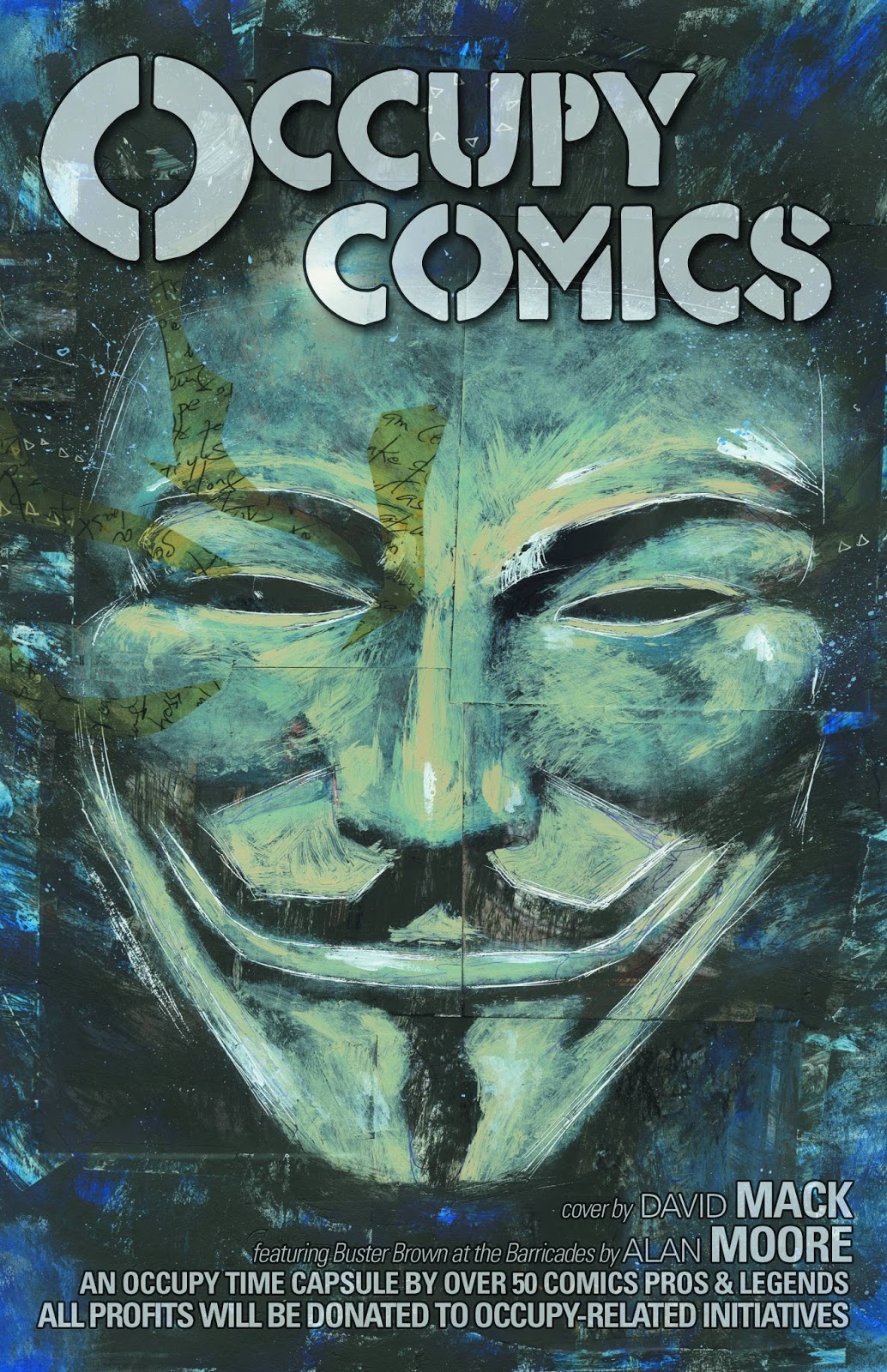
Last week, the third issue of Black Mask's crowdfunded benefit anthology, Occupy Comics came out. The comics haven't really been the main event in OC for me as much as Alan Moore's stunning serialized essay on the history of comics, Buster Brown at the Barricades. As good a concise (if hardly neutral) history of comics you will ever read, Moore packs in an extraordinary amount of vividly portrayed historical context into each dense, fiery installment. The final chapters of his essay (written last summer) finally saw print in Occupy 3 and covered the underground comix counterculture of the 1960s all the way through to the present day comic scene. All told, Buster Brown is a fascinating, illuminating and flawed history/opinion of comics told by one of the medium's finest creators.
![]() |
| Buster Brown at the Barricades by Alan Moore, to be collected in Occupy Comics TPB in Nov. |
Most of his essay is solidly mixed with righteous anger over treatment of creators past and present, logical and defensible frustrations with mainstream quality, and a large amount of outright bitterness. He rails against mainstream comics as universally moribund and quality-free. But his passionate rejection of anything remotely mainstream finds him wildly missing the mark in several places. He notes the cutting edge work of Neil Gaiman, Warren Ellis, and Garth Ennis, stating that all three would go on to "relocate to an area of the comics landscape that was as far distant from the mainstream as possible." Which is of course gibberish: all three continue to work solidly within the mainstream American comic market, with all three working for Marvel this year alone. He focuses, appropritately, on both the creative and aesthetic harm Image comics caused the industry during the speculator bubble of the 1990s, only briefly mentioning the company's current "progresive and creator-friendly" place in the market. This is an underestimation and understatement of the company's vital role in a stunning renaissance of critically acclaimed, best-selling, entertaining and high quality creator-owned material being published now.
Moore's narrow view that there is absolutely nothing good in the mainstream wasteland is, of course, spurious bullshit. In Donna Bowman's remarkable series of essays on Breaking Bad for The AV Club, she outlines a similar corollary in television that I think deserves full quoting:
It's easy to look at television, with its 500 channels worth of endless crappy versions of the same empty ideas, and conclude that everything's gone to shit ... [proclaiming] the dreary, inevitable decline of entertainment, and answer my protests to the contrary with assertions that searching for the few worthwhile nuggets in that morass is a pointless waste of their time. Ironically, this pronouncement coincides with the greatest flowering of televised drama and comedy in the medium's history ... the best television ever is on the air right now, in this decade.An identical thing can be said about comics. Moore does point out the many independent works of high quality being produced, and ends on an uplifting note imploring anyone, everyone to create comics. But his blind rejection of anything mainstream, anything popular, writes off truly great material being produced in those arenas. Sturgeon's Law says ninety percent of everything is shit. But that means ten percent is decidedly not. Regardless of the true ratio, the basic tenets of Sturgeon's Law apply regardless of genre and medium. Bowman argues that we are in a golden age of television, and I would argue that in so many ways we are in a true golden age creativity, accessibility, quality and cultural penetration for comics. Moore acknowledges elements of this, but over-focuses on the low quality work in the mainstream. There's nothing wrong with advocating for new, better, different, but there's nothing wrong with the high quality, entertaining and exhilarating works being produced in the mainstream either.
But Alan Moore does absolutely nail it in so many places in his essays, of course. In pieces like Buster Brown in Occupy Comics and his series of enlightening historical essays in Dogem Logic, Moore has shown himself to be a true historian of stunning quality. But that isn't to say his view is perfect or should be taken for granted. When you refine a genre or medium or focus on a particular piece, Sturgeon's Law actually flipflops the ratio, and the bad is outweighed by the good. And in Buster Brown, the good is absolutely pervasive, but still mixed with just a little bit of narrow minded nonsense, not to mention Moore's own blatant whitewashing of his own role contributing to the mainstream he so vehemently rejects.
--
I'll use two cogent sequential passages from Moore's Buster Brown about the 1990s boom-bust but still relevant today to launch into this week's books.
Desperate gimmickry prevailed in limited-edition special-cover efforts to distinguish one book from the next, there being nothing in the content, style or presentation of the work with which to otherwise make such distinctions.Ladies and gentleman, welcome to Villain's Month, DC Comics pointless money grab featuring underprinted lenticular (3D) covers slapped on poorly made soon-to-be thrown out garbage. A month of pointless stories created for the sole purpose of selling fancy covers, a key example of the creative bankruptcy certainly prevalent at DC.
"Crossover events," transparent ploys to make loyal and trusting readership buy every title in the line for fear of missing some important part of a ridiculously sprawling and incomprehensible non-story, would become the major companies' sole strategy for selling their directionless, lacklustre wares.Ladies and gentleman, welcome to Marvel's event-thing, Infinity. I'm sick and tired of events, and the recent track record of Marvel events has been wanting, to be needlessly generous. But I've been enjoying Infinity, crafted by one of modern mainstream comics truly new and unique visionary talents in Jonathan Hickman. There are certainly pointless tie-ins meant to suck up dollars, but I believe the comic audience is bright enough to know what these are and skip them. The necessary bits of Infinity, hardly a non-story but certainly arguably incomprehensible to the uninitiated, aren't quite as sprawling as events past. So what about this week's Infinity 2? It was a decent, entertaining middle chapter, gorgeously illustrated by the amazing Dustin Weaver and Jerome Opena with a slightly silly twist at the end, sure, but you sure get your bang for your buck with this series.
Not to be outdone with just one crossover, oh no!, Marvel also put out the first two chapters of Battle of the Atom by the consistently inconsistent Brian Michael Bendis and the consistently awesome Frank Cho and Stuart Immonen. This is one of those old-timey X-book-x-overs that sprawls across a bunch of different titles and creative teams (see my breakdowns of crossover types from last week), these chapters in a one-shot and All-New X-Men. Bendis only falls into his usual verbal traps in the second part but thankfully we've got Cho and Immonen to make it shine. The story is surprisingly straight-forward (things are TOO timey-wimey so that has to be stopped ASAP) and I loved the nice little twists in the future X-Men team (Princess Power!). I tend to dislike Time Travel nonsense so hopefully this wraps up all those stories. Hopefully.
It was a pretty light week, but there were a couple of good releases worth noting: Satellite Sam 3 by Fraction & Chaykin was superb, Trillium 2 by Jeff Lemire was as beautifully drawn and compelling as the first issue, Daredevil Dark Nights 4 by David Lapham was weird and entertaining, and Superior Spider-Man 17 was gimmicky, sure, but I've been digging this whole run, so what the hell.
And of course a must-own, Love and Rockets: The Covers finally came out, and it was most definitely worth the wait. (By the way, if you haven't had a chance, check out my Definitive Love and Rockets Guide!) Happy Wednesday, everyone!
Posted In:
alan moore,
book reviews,
comic reviews,
quick hits,
Wednesday review
Location:
Brooklyn, NY, USA
Wednesday, August 28, 2013
The Wednesday Review: Sex and Crossovers
In the last couple of weeks there have been some more than a few discussions about the role of depictions of sexual violence in comics. Joseph Hughes on Comics Alliance had a good rundown of the controversy revolving around Mark Millar's use of rape in his Kick-Ass comics, and Millar's dismissive opinion of that use. Warren Ellis has made a good argument elsewhere that violence in fiction is a necessary outlet and artistically valid. I've long been bothered by fictionalized rape in comics, but don't blink when someone gets decapitated (like in the new Lazarus 3) or blown up or whatever horrifying sci-fi violence cooked up by creators the world over. But Laura Hudson is right: rape and other forms of violence are simply not equivalent. But. And there's always a but: The discussion has been focused on sexual violence against women, as it should be, but what about sexual violence against men?
Well, depictions of men being raped almost never happens, outside of (usually) jokes about prison rape. So I was mildly startled by the brutal rape of a male character is Joe Casey and Piotr Kowalski's Sex #6. I've written about Casey & Kowalski's Sex previously in the Wednesday Review; I dig this title more with every single issue. A delicately paced corporate future-shock post-superhero character crime drama with the occasional sex scene, everything that has been drawing me further into this compelling and unique comic is on full display in this issue. But there is also a sequence where the big bad of the series has a male computer wiz - described as a "bitch" on the recap page - beaten and raped for information. If this same scene involved the torture and rape of a woman, everyone and their non-comic reading cousin would be calling for Casey's head and coming at comic shops with pitchforks. But because the rape is of a man, will anyone even care? And, hell, do I ultimately care? Sex has been so good, while this scene took me out, everything else just drew me back in. Rest assured, the sex in Sex is not of a violent type, and the consensual sex scene in the comic is pretty hot and not remotely gratuitous. But the rape scene in Sex is pretty damn uncomfortable and I can't tell if Casey is trying to play it up for laughs, and if he was, then that may be the nail in the coffin for this book - which is a damn shame because it has been excellent up to this point. The jury's still out I guess. I just wish it didn't have to be.
Switching gears, please/thanks, are two absolutely wonderful superhero comics from Marvel. I've gushed about FF by Matt Fraction and Mike Allred before, and - just as Fraction's leaving the book to get his Inhumanity on - the team produces yet another one-shot mini Marvel masterpiece in issue 11. Packed with the series' wonderful humor, compassion, logic and flair, the Replacement Four go off to find the Fantastic Four, but get shanghaied by the Impossible Man looking for help with his son. Elsewhere, the robots continue to steal scenes and Maximus the Mad runs into Julius Ceasar. Oh, and Mike & Laura Allred owned This Week in Superhero Comics. I''m being light on details, because this is a book to be enjoyed, not told about, so go out and enjoy it while the getting is good. In the same league is Kieron Gillen and Jamie McKelvie's Young Avengers 9, brimming with inventive energy, character moments fraught with high drama, stunning art, and plot out the wazoo. Featuring endings and beginnings and twists to spare, this is a good point to jump on if you haven't yet. Or better yet, pick up the first trade paperback out today and see what all the fuss is about.
There are three key kinds of crossovers in American mainstream comics: the first where two titles from different universes cross over into each others stories; another is where a bunch of different titles in a shared universe tie-in with a common storyline (nowadays usually called an Event); and the third is where a one sequential story is told across multiple titles. The current storyline in Mike Carey and Peter Gross's usually superb Vertigo ongoing Unwritten 52 is an example of the first, with Tom Taylor (well, a Tom Taylor) and crew popping up in Bill Willingham's Fables. As Unwritten is very much a long-form closed story and not an open-ended superwhatever comic, this crossover isn't the type seen most often with this format where different protagonists just get mashed together for a few issues - we can be assured that the events that transpire are part of a long-held plan. But "The Unwritten Fables" still feels unnecessary, despite the fact that this will be the last arc of The Unwritten before a hiatus and perfunctory renumbering this winter. The Unwritten are bouncing around the Fables-verse when Mr. Dark was still the main villain (so, like, a year and a half ago) and the long sequences focusing on the Fables and their dealings with Mr. Dark, despite the thrill of Gross's interpretation of Mark Buckingham's Fables, just seem tired and irrelevant. I used to anticipate new issues of The Unwritten, now I can't wait for this story to be over so we can get on with business as usual.
Then there is the Event, oh, the Event, the accursed, money-grabbing corporate Event. Right now in the Marvel Universe, its Jonathan Hickman's Infinity, but in Hickman I trust and he doesn't let me down in New Avengers 9. A superb, riveting superhero comic playing an integral part in his cosmic epic, it manages to also provide the next chapter in his long-running Illuminati-heavy arc while pumping out a ton of action from Wakanda to Westchester, really spectacularly illustrated by Mike Deodato within Hickan's impeccable production design. And I don't usually like his art, but Deodato and colorist Frank Martin are a lot more detailed, a lot more accessible and a lot less muddy here. I've long preferred the New amongst Hikman's two Avengers titles, and this continues to hold up. I wish I could say the same about other books in the crossover, or, more properly the dreaded "Tie-In": Avengers Assemble and Captain Marvel just cover the same tracks as Hickman's Avengers 18. But some amount of filler is to be expected in Events, and to be avoided. Stick to Hickman throughout Infinity and you won't be disappointed.
The third type of crossover will be happening soon in all the key Marvel X-books (which tend to be the books that usually do this kind of crossover). Starting next month is Children of the Atom, where its revealed that Astro Boy has fathered every mutant in the Marvel Universe. Or not, I don't know what its about. I just know that it will be disrupting Wolverine and the X-Men, which concluded one hell of a story in issue 35 today. Jason Aaron and Nick Bradshaw are firing on all cylinders together, and Aaron's lighter, poppier, high-fun superhero style is always a delight to read from the increasingly chameleonic creator. I know Aaron will handle this crossover with the same skill he has others, I'd just rather see him continue to do his own thing.
Lets close with a Dark Horse three-pack: Itty Bitty Hellboy 1, the Aw Yeah-ification of Mike Mignola's Hellboy/BPRD-verse by all-ages impresarios Baltazar and Franco was sadly disappointing. I really enjoyed their Tiny Titans comics, and am genuinely looking forward to their upcoming Kickstarter-backed creator owned book, but their Hellboy outing just falls flat. ... What's with Brian Wood and nuclear weapons in New York City? DMZ pretty much jumped the shark when the nuke showed up there. In Wood's Massive 15, the pissed off guy with the stolen nuclear submarine faces off with what's left of the U.S. Army while people on the Kapital reminisce about melodrama, and it all just breaks down into a sequence about as riveting as Itty Bitty Hellboy. And then the nukes got launched, but were stopped by Clarke's star child like in 2001 (the novel). No, but, seriously, the Earth just gobbled them up, according to the news channel that is somehow still broadcasting post-Crash. Massive continues to alternate between intriguing and patently ridiculous. ... But Matt Kindt's MIND MGMT 14 was pretty damned good as usual, so there's that.
Happy Wednesday, everyone!
![]() |
| Sex 6 |
![]() |
| FF 11, Young Avengers 9 |
![]() |
| Unwritten 52, New Avengers 9, Wolverine and the X-Men 35 |
Then there is the Event, oh, the Event, the accursed, money-grabbing corporate Event. Right now in the Marvel Universe, its Jonathan Hickman's Infinity, but in Hickman I trust and he doesn't let me down in New Avengers 9. A superb, riveting superhero comic playing an integral part in his cosmic epic, it manages to also provide the next chapter in his long-running Illuminati-heavy arc while pumping out a ton of action from Wakanda to Westchester, really spectacularly illustrated by Mike Deodato within Hickan's impeccable production design. And I don't usually like his art, but Deodato and colorist Frank Martin are a lot more detailed, a lot more accessible and a lot less muddy here. I've long preferred the New amongst Hikman's two Avengers titles, and this continues to hold up. I wish I could say the same about other books in the crossover, or, more properly the dreaded "Tie-In": Avengers Assemble and Captain Marvel just cover the same tracks as Hickman's Avengers 18. But some amount of filler is to be expected in Events, and to be avoided. Stick to Hickman throughout Infinity and you won't be disappointed.
The third type of crossover will be happening soon in all the key Marvel X-books (which tend to be the books that usually do this kind of crossover). Starting next month is Children of the Atom, where its revealed that Astro Boy has fathered every mutant in the Marvel Universe. Or not, I don't know what its about. I just know that it will be disrupting Wolverine and the X-Men, which concluded one hell of a story in issue 35 today. Jason Aaron and Nick Bradshaw are firing on all cylinders together, and Aaron's lighter, poppier, high-fun superhero style is always a delight to read from the increasingly chameleonic creator. I know Aaron will handle this crossover with the same skill he has others, I'd just rather see him continue to do his own thing.
Lets close with a Dark Horse three-pack: Itty Bitty Hellboy 1, the Aw Yeah-ification of Mike Mignola's Hellboy/BPRD-verse by all-ages impresarios Baltazar and Franco was sadly disappointing. I really enjoyed their Tiny Titans comics, and am genuinely looking forward to their upcoming Kickstarter-backed creator owned book, but their Hellboy outing just falls flat. ... What's with Brian Wood and nuclear weapons in New York City? DMZ pretty much jumped the shark when the nuke showed up there. In Wood's Massive 15, the pissed off guy with the stolen nuclear submarine faces off with what's left of the U.S. Army while people on the Kapital reminisce about melodrama, and it all just breaks down into a sequence about as riveting as Itty Bitty Hellboy. And then the nukes got launched, but were stopped by Clarke's star child like in 2001 (the novel). No, but, seriously, the Earth just gobbled them up, according to the news channel that is somehow still broadcasting post-Crash. Massive continues to alternate between intriguing and patently ridiculous. ... But Matt Kindt's MIND MGMT 14 was pretty damned good as usual, so there's that.
Happy Wednesday, everyone!
Posted In:
comic reviews,
quick hits,
Wednesday review
Location:
Brooklyn, NY, USA
Thursday, August 22, 2013
Tragedy and The Perils of Subjective Reality in Adventure Time 19
Overture: In lieu of The Wednesday Review, I take a look at the remarkable Adventure Time 19's approach to tragedy, loss, madness, and issues of subjective versus objective reality and its thematic similarities to Lem/Tarkovsky/Soderbergh's Solaris.
--
It's a volume-light, quality-unremarkable Wednesday for single issues (for me, anyway), but one remarkable stand-out comic makes the calm before next week's likely flood of new books worth it: Adventure Time 19 by Ryan North, Shelli Paroline & Braden Lamb.
I've mentioned Adventure Time (the show and the comic) quite a bit here on The Comic Pusher, and for good reason. Pendleton Ward's remarkable creation is an inventive character-based action-adventure comedy with consistently superb storytelling in a richly detailed fantasy world populated by entertaining and emotionally realistic characters. Throughout the subtle and effective continuity of the series are woven increasingly complex stories of heartbreak and loss, madness and despair, love and friendship and mysteries of science and magic and the heart. Despite being fiction aimed at younger audiences, Adventure Time often presents a level of emotional maturity and humanism that one would be hard-pressed to find in most fiction of any stripe. The best Adventure Time comics reflect this duality of accessible high-energy storytelling interlaced with thematic maturity. Where the ongoing Adventure Time comic is always entertaining but can be sometimes uneven, two mini-series - 2012's Marceline and the Scream Queens by Merdith Gran and Natasha Allegri's Fiona and Cake from earlier in the year - each represented some of that year's best comic storytelling. And today's issue 19 from writer North and artists Paroline & Lamb ranks with the very best we have yet seen in this remarkable universe.
The last part of a story arc, the issue opens at the conclusion of the previous one with Finn, Jake, and Ice King on a dungeon quest, scattered across the multiverse by the remnants of The Lich. The dimension Finn ends up thrown into is the "Farmworld" dimension (from the season five three-parter), a reality where Simon Petrikov stopped the Mushroom War a thousand years earlier and where Finn has a human family and Jake is just a dog. Finn can easily see through the benefits in this dimension as nothing more than an illusion set up to entrap him. He escapes and breaks Jake free from his counterfeit reality (where everyone has Jake powers; "Oh, so that's what this feels like!"). They end up in Ice King's reality, and try to convince him to leave. But he doesn't want to.
Early on in Adventure Time, The Ice King was an annoying villain of the week, set up again and again to get punched down by Finn and Jake. But nothing is ever quite what it seems on Adventure Time, and Ice King was slowly changed from the central villain - at first presented as a wizard king with ice-ninja powers, more goblin than human - to the central tragic figure (and occasional ally of Finn and Jake). A full thousand years before the events of the series, Ice King was a normal human, Simon Petrikov. Simon was an archeologist who was in a happy relationship with the love of his life, Betty. At some point, he discovered the mystical grimoire The Enchiridion and the Ice Crown, an object not unlike Tolkein's One Ring. He puts on the crown and is granted immense power, at the expense of his relationships and career. Betty leaves him, and soon afterwards the Earth is engulfed in biological and nuclear war. Petrikov survives thanks to the Ice Crown, and encounters the young vampire Marceline Abadeer in the mutating ruins of the Earth. While trying to protect Marceline, Simon repeatedly resorts to using the Crown for the powers it gives him. But the cost on his psyche and his soul is too great. He and Marcie survive, but Simon falls completely under the Crown's spell - he looses all memory and develops his current malicious persona. He would survive, immortal, but at the total cost of his humanity, forever plagued by unrelenting hallucinations, with no memory of his past.
What transpires in Adventure Time 19 would be no less powerful on its own, but is even more moving in light of the knowledge of Ice King's immutably tragic past. Finn and Jake come across Ice King and his fiancee, Betty. They try to convince Ice King that Betty and the world aren't real, but an illusion of the Lich. "Betty" recalls details of their shared past to prove her actuality, but Finn asks how Ice King can possibly know that what she says is true. Ice King reveals that "Here, I can remember. Here I can think clearly ... There's no cost, no price" to the Ice Crown's powers. Betty takes the crown and makes an ice-construct, emblazoned with the words "Everything is beautiful and nothing hurts." As the world around them bursts into flame, Ice King single-mindedly pleads his case: "This feels like reality, only better. This Kisses like reality, only way way better. ... It's a paradise ... I can finally BE that person I remember." But Finn and Jake won't let Ice King fall victim to this reality - despite whatever Ice King feels and believes, the subjectivity of his experience, the true reality is darker, a controlled illusion, and they break him free. As their world burns down around them, "Betty" screams in pain and Ice King reaches out to her. "Simon, I-I don't feel fake-" she pleads. "You're just as real as I remember," he says as she crumbles into dust in his arms.
--
In Solaris, a psychologist, Chris Kelvin, is sent to a space station orbiting an alien world, Solaris, where something very wrong has happened to the crew of the station. When he gets to the station, the surviving crew reveal that the planet is living and reaching into their minds and creating constructs of people from their pasts. These constructs are not human but look and act human. Or at least some version of it. It doesn't take long for Kelvin's construct to arrive, his dead wife. But this isn't his wife, no matter what his senses tell him - just like Betty in Adventure Time 19, she is just a simulacrum of his memories of her. But in the end Kelvin chooses death on the planet to be with this copy of his passed wife rather than go back to the objective reality of loss and pain.
Indeed, Ice King consciously makes the same exact choice as Kelvin in Solaris, completely acknowledging the objective artifice of the subjective reality he is experiencing. Both Solaris and Adventure Time 19 raise powerful questions about choice and reality. Ice King is plugged into the Matrix and is fine with it. And can you blame him? For the first time in centuries, Ice King can be Simon Petrikov, he can be sane and sound of mind, and live happily ever after with the woman he loves. Even if this is not objectively real, even if Betty is a construct made from his own buried memories, for him it is undeniably subjectively real. And subjective reality is no less real to the one experiencing it as supposed objective reality. He chooses painless suicide wrapped in the entrancing embrace of love and sanity over pain and loss and madness because who wouldn't make that choice. This isn't a matter of Ice King not knowing the consequences of his actions but accepting them with open arms.
Finn and Jake break Ice King free, but not without a note of recognition of pain and sadness from Finn and Jake. In a brief moment of lucidity when he doesn't have the Crown infecting his mind, Ice King recognizes the necessity of their actions. And he puts on the Crown and goes back to the only world he knows. If there is any silver lining to Ice King's tragedy, the effects of the Crown will make him forget the brief moment of happiness he felt. That reality is wiped away from existence completely, objectively and subjectively.
This isn't the first time the Adventure Time franchise has played with the themes of subjective reality. In the episode Puhoy Finn falls into an elaborate pillow fort and finds himself transported to a pillow world where he grows to be an adult, gets married, raises a family and dies of old age, only to come out of the fort. The memories of that time melt away like a dream, but it is more than suggested that Finn lived out those decades fully and completely. It was real to him for that entire lifetime whether or not it was an objective reality.
--
There's even more to this issue as Finn, Jake and Ice King team up on the remnants of The Lich, in what is clearly a parable about the fight against depression and encroaching madness that many people battle every day. Capturing the insidious manner that depression can be used as a weapon against the Self, the Lich taunts Ice King: "I knew your secrets. I knew your failures. I knew the people you've hurt, and better, the people you've let be hurt. Why do you fight? It's hopeless." Ice King, after acknowledging his failures, notes "Giving up is easy. You know what's hard? To believe in your own worth, to know you've got something special in you ... even when you can't see it." North, in a small space that seems like pandering feel-good philosophy to get out of the conflict, really captures the infective echo chamber of depression and the first steps to escaping it. Whether or not in the long term Ice King can find peace, free from madness and amnesia, is to be seen, but increasingly as the series goes on you hope more and more for him.
Many live action dramas and long form comics cannot do what Adventure Time frequently accomplishes. It is elements like these that give Adventure Time a unique place as a hugely popular and hugely entertaining fantasy-adventure comedy that tackles complex themes with the amazing maturity and subtlety of literature.
--
Adventure Time 19 is in stores today, and airs Mondays and in frequent re-runs on Cartoon Network.
Posted In:
adventure time,
boom,
comic reviews,
Wednesday review
Location:
Brooklyn, NY, USA
Wednesday, August 14, 2013
The Wednesday Review: Sagas and Epics
I really love Saga by Brian K. Vaughan and Fiona Staples; issue thirteen came out today after a small hiatus. 126 day hiatus, but who's counting? Anyway, back in April - when JHU Comic Books was still Jim Hanley's Universe - I wrote a fan letter to Saga, my first letter to a comics letter page (snail mail, no less). To my utter geeky glee, that letter saw publication in today's new #13, which you can see it to the right, and everything I say there still stands.
Clearly I'm in love with Saga, and there is more than enough of a critical and popular consensus that shows that lots of folks are just as enamored with it as I am. And today's new issue illustrates all the reasons why this comic has been such a critical and commercial success (outside of the only reason that really matters: being a damned good comic).
First and foremost are the creators and the quality of their collaboration. Vaughan's story would be meaningless without Staples' flawless execution. She captures everything Vaughan asks for - character work and completely remarkable setting - with a unique and wonderful style. But while the creators got me in the door, what keeps me coming back are the characters. Every single character in the comic is complex, entertaining and relatable, and like all the best stories the characters drive the plot rather than simply fall victim to it. The pacing of the plot is intricate and clearly playing a very, very long game while making each chapter a riveting stand alone tale often featuring breathless cliffhangers. But as much as anything, Saga's greatest strength is its attitude.
I'm talking about the attitude of the characters and the attitude of the setting. Despite being aliens far, far away, the characters talk and act like people talk and act now. Despite the mixture of space opera and high fantasy, so many elements of the plot can best be described as reflective of 2013 rather than whatever world Vaughan and Staples has built. The trap with science fiction and fantasy is to spend too much time and energy on world-building something radically other. Which isn't to say, with its mix of magic and space-alien sci-fi, that there aren't radically wonderful and unique elements that follow their own internally consistent logic in Saga. Vaughan and Staples just don't get bogged down in unnecessary details, choosing the understandable and accessible wherever possible. There's the red-tape infused veterans hospital at the beginning of the issue (replete with shopping-cart pushing whino) and the presence of shady tabloid reporters and The Will's frustrations with trying to get his ship fixed (after being put on hold he's told he's out of the coverage zone), just to name a few things. There's also magic and bone bugs and hallucinations of lost loves and mourning and hilarious first impressions.
Saga uses its unique setting and extraordinary characters to explore fundamental questions about family and love while telling an absolutely riveting, richly layered, often funny, always true to character, and completely unpredictable story. There are a lot of good comics, but nothing that creates and fills the niches that Saga does, let along with its continued level of success. I'd like to think that - as someone who sells comics for a living and writes about them as a passion - I can approach it objectively, that if there was a bad issue that I could say so. There just hasn't been a bad issue yet, and it somehow manages to get better.
![]() |
| Saga, Infinity, Thor |
Thor #11 saw the conclusion of Jason Aaron and Esad Ribic's massive opening storyline. And make no mistake, this is a decisive full-stop conclusion, one featuring astonishing imagery at the end of a fantastic and exciting story. It's always remarkable to see Aaron stretching so many diverse creative muscles in his career, and Ribic pulls off some really breathtaking stuff here. If you've been reading the story up to now then you are already getting this issue, but if you have been on the fence, then go out of your way to get the graphic novel when it is collected. For the Thunder God, this whole storyline ranks with the best of Straczynski/Coipel/Djurdjevic and Simonson runs, and as a concise complete work is second only to Oeming and Di Vito's often overlooked Thor: Disassembled.
A bunch of other good books came out today, too. East of West 5 from Hickman & Dragotta was astonishing, with downright arresting imagery. Wolverine and the X-Men 34 from Aaron and Bradshaw continues to be really fun, lushly illustrated and fabulously entertaining. And Fantagraphics continued their gorgeous line of EC reprint hardcovers with new Al Feldstein and Johnny Craig collections.
Happy Wednesday, everyone!
Posted In:
brian k. vaughan,
comic reviews,
Image,
marvel,
quick hits,
Wednesday review
Location:
Brooklyn, NY, USA
Wednesday, August 7, 2013
The Wednesday Review: Creator Pwnage All Over The Place
A full half of the books I read this week were creator-owned. I usually read a bunch of creator-owned books, but the proportion is much higher this week. And the proportion of damned good books was higher this week as well (not a coincidence). J. Michael Straczynski gives us two offerings from Joe's Comics, Jeff Lemire raises the Vertigo creator-owned banner, Panel Syndicate for the win, and much more in this week's Wednesday Review.
J. Michael Straczynski is going to have one a hell of a year. Outside of work-for-hire gigs doing new Twilight Zone and Terminator books, his Joe's Comics imprint at Image is set to restart Book of Lost Souls & Dream Police, Protector's Inc is coming in the fall, he's got a trippy book with Bill Sienkiewicz in the wings, and at least two more projects that I'm forgetting. Dude's busy. And as an avowed fan of the Great Maker, I'm pretty bloody excited.
Ten Grand with Ben Templesmith has been going strong and issue four this week ratchets up the stakes significantly. Joe Fitzgerald knows something's amiss in Heaven and Hell, and he has to sacrifice quite a bit of himself to find answers. Templesmith's art continues to be perfectly suited for Straczynski's story, filled with demons and dark alleys and pain and suffering. There's a nifty sequence where Fitzgerald talks to a broken ghost and a brutal fight with demonic types and we're just getting warmed up. I'm really enjoying this book.
And today also sees the release of Sidekick #1 with Tom Mandrake. In the backmatter, Straczynski professes a hate for sidekicks, and it certainly shows here. Flyboy, the sidekick to the superpopular superhero the Red Cowl finds himself rudderless, jobless and broken after Red Cowl is brutally gunned down. No-one believes Flyboy can cut it on his own, and things turn shitty pretty quickly. Resorting to shaking down hookers for blowjobs and creating false crimes for credit in police reports, things continue to spiral out of control for him. And things get worse, and worse, and worse for Flyboy. This is really funny, really mean, really entertaining stuff. We usually don't get such visceral authorial cruelty with corporate sidekicks, and, gawd, do I ever agree with Straczynski that such treatment would be more than welcome. Straczynski isn't the first to tackle the incongruities of sidekicks - see Rick Veitch's Bratpack - but Sidekick is certainly a lot of fun. Even more so if you replace Flyboy with your sidekick of choice in your head. Seriously, fuck those guys.
Trillium is Jeff Lemire's fully creator-owned Vertigo follow-up to his recently completed Sweet Tooth. I've been really digging Lemire's stuff (though Sweet Tooth was quite uneven), and the cover to Trillium was honestly enough to sell me on it. Well, one of the covers - it's an honest to goodness flip book, the stories in each half of the book meeting in the middle. "Chapter 1: 3797 - The Scientist" was enough to sell me on the book for the long haul. What's left of humanity is on the run from a sentient virus, they've been chased to the edges of time and space and their only hope may be in a flower (the titular Trillium) controlled by an alien species. Nika, the scientist, goes out to the aliens to negotiate anything to help humanity, and things take some fantastic turns. My description does not do Lemire's story justice. The setting and details of the future Lemire paints are astonishing. And his art here is leaps and bounds beyond what I'm used to from him. What's not colored by longtime collaborator Jose Villarrubia is water-colored by Lemire in a style seemingly inspired by good friend Matt Kindt, and that is a good thing. The other half of the book, which takes place in 1921, follows a former soldier exploring the Amazon. There is more to his story, and it connects to Nika's, but I won't say how. Trillium is that rare species, an innovative new fully creator-owned book from Vertigo from one of comics' most distinct voices, and seems it will be worth seeking out and sticking with.
I loved Matt Fraction and Howard Chaykin's Satellite Sam 1 a ton. I love today's #2 with as much tonnage. Prophet 38 is just as impenetrable as the rest, but good grief is it a weird, wonderful little book to just kind of pour over. Brandon Graham, Simon Roy and Giannis Milonogiannis are sure doing something. Who the hell knows what it is, and that's alright. The Brubaker/Phillips Fatale 16 seems like the weakest issue of the series, but that's like saying I'm not really liking this duffel bag of diamonds that just fell in my lap. But, hey, lots of stuff happens and I still can't wait for more. A whole hell of a lot happens in Manhattan Projects 13, my favoritest Jonathan Hickman book. We begin to see the puzzle of the various Projects, and the games being played behind the scenes. Oh, and coked out Kennedy. This book, from Hickman's unhinged story and characters to Nick Pitarra's expressive art, is always so much fun to read.
The most successful creator-owned superhero comic of the last decade or so, Kick-Ass 3 #2 came out today, too. I continue to enjoy the attempts by normal idiots doing superheroic stuff with only superhero comics as a touchstone, I just don't care about any of the characters. After five years, the book just doesn't have the same pop. But I've stuck with it this long, may as well see it through to the end. And it wouldn't surprise me if Mark Millar and John Romita, Jr. surprised me in that end. I hope. And finally, over at Panel Syndicate, Marcos Martin puts those ridiculous DC "Director's Cuts" to shame by publishing the entire behind-the-scenes process of his and Brian K. Vaughan's Private Eye. Why pay $5.99 for warmed over crap when you can pay what you want for a whole art-book worth of material covering one of the year's best comics with all the money going to the creators. No question mark, that's rhetorical. Go to Panel Syndicate and melt your brain.
--
Comics! They're a thing, y'all! Read my other Wednesday Reviews here. Read my essay on J. Michael Straczynski here. Read my essay on Panel Syndicate here. And check out Comic Pusher on Facebook here, because Facebooks are a thing in this future we got even if its not the future we want.
![]() |
| Ten Grand 4, Sidekicks 1, new from Joe's Comics |
Ten Grand with Ben Templesmith has been going strong and issue four this week ratchets up the stakes significantly. Joe Fitzgerald knows something's amiss in Heaven and Hell, and he has to sacrifice quite a bit of himself to find answers. Templesmith's art continues to be perfectly suited for Straczynski's story, filled with demons and dark alleys and pain and suffering. There's a nifty sequence where Fitzgerald talks to a broken ghost and a brutal fight with demonic types and we're just getting warmed up. I'm really enjoying this book.
And today also sees the release of Sidekick #1 with Tom Mandrake. In the backmatter, Straczynski professes a hate for sidekicks, and it certainly shows here. Flyboy, the sidekick to the superpopular superhero the Red Cowl finds himself rudderless, jobless and broken after Red Cowl is brutally gunned down. No-one believes Flyboy can cut it on his own, and things turn shitty pretty quickly. Resorting to shaking down hookers for blowjobs and creating false crimes for credit in police reports, things continue to spiral out of control for him. And things get worse, and worse, and worse for Flyboy. This is really funny, really mean, really entertaining stuff. We usually don't get such visceral authorial cruelty with corporate sidekicks, and, gawd, do I ever agree with Straczynski that such treatment would be more than welcome. Straczynski isn't the first to tackle the incongruities of sidekicks - see Rick Veitch's Bratpack - but Sidekick is certainly a lot of fun. Even more so if you replace Flyboy with your sidekick of choice in your head. Seriously, fuck those guys.
![]() |
| Jeff Lemire's Trillium, new from Vertigo |
![]() |
| Image, Image, Image, Image. |
![]() |
| And then this happened. |
--
Comics! They're a thing, y'all! Read my other Wednesday Reviews here. Read my essay on J. Michael Straczynski here. Read my essay on Panel Syndicate here. And check out Comic Pusher on Facebook here, because Facebooks are a thing in this future we got even if its not the future we want.
Subscribe to:
Posts (Atom)