Showing posts with label analysis. Show all posts

Tuesday, August 6, 2013

Understanding Time

Overture: Here I look at Randall Munroe's xkcd comic experience Time, from reviewing his remarkable story to detailing the extraordinary lengths Munroe went to in its experimental publication. Published in 3099 hourly panels over 123 Days, some describe the work as a type of unique animation, but I make the argument that it is a comic first and foremost - indeed a monumental achievement of the form and one of the most important works of the year.
--

Randall Monroe's xkcd has long been one of my favorite webcomics. Munroe, a former NASA scientist turned full-time cartoonist, produces entertaining, thoughtful comics and astonishingly detailed infograms featuring a unique mix of esoteric subjects focusing on math, science, history, computer programming - and often matters of the heart. His cartooning style, extremely basic stick figures sometimes mixed with intricately detailed natural illustration all within an impeccable minimalistic design aesthetic, manages to be deceptively simple and representative while translating a surprising amount of emotion. Often hilarious and thought provoking, and always very, very smart, xkcd's unique nature has won the title a devoted and extremely creative and intelligent legion of fans.

In March, Munroe published xkcd #1190, Time. At first it was unclear what Munroe's intent was with Time; the comic consisted of a single panel of two figures sitting on a beach. Then the image changed. And it began to change, incrementally, every half hour at first, then every hour. Some panels would feature a small change from the previous one, showing a small fraction of time passing; others contained dialog and events and changes in scenery indicative of minutes or hours passing. Every hour, a new panel would be published over the old one, and this would go on, every hour without stopping... for four months. Time finished last week, after 3099 frames. That is a comic in 3099 panels, with each panel published every hour for 123 days.

As soon as the xkcd fan base saw what Munroe was logistically attempting, intrepid fans created websites to track the comics' process, even if they didn't know the scope of what he was doing (and he wasn't saying) - the best is The Geekwagon Time reader. There you can "watch" the comic, controlling the frame rate, stopping at any point or reading it frame by frame. But that doesn't even scratch the surface, as there was a 1300 page discussion forum thread on the comic and an entire wiki devoted to just Time. But what started out as a fun project to track a unique experimental comic, turned into a vibrant community of scientists and artists and everyone in between decoding the comic's many mysteries. The discussion changed from the what and how to the why of the story, which is in itself another remarkable achievement.

The comic progresses. The two unnamed figures, a couple, start building a sand castle. As time goes on (or as Time goes on) the castle grows increasingly elaborate. They don't say much, lost in the business of creation. But something is happening. The woman looks out from their creation, and says the words that will impact the rest of their lives: "I don't understand what the sea is doing." There's something profoundly wrong, and they go on a journey to discover why the sea is rising faster than they have ever seen. As they journey out, it becomes clear that they have not been far from home in their lives, and they don't seem to know about basic things about the natural world. The journey is hard, and over days they continue to go higher and higher up the "mountains" that surround them, encountering many animals and plants they have never seen, and further mysteries about the inundation happening around them. Inspired by a sense of discovery, they drive forward, further and further into an uncertain future.

As the land begins to level out, they encounter evidence of human settlements that have been hastily abandoned. The more new things they discover, the deeper the mysteries that unfold. At the top of the "mountains" they encounter a group of people speaking a language they don't understand. After some pictographic communication, they are introduced to someone who can almost speak their language. This woman, the group's leader and chief scientist, manages to tell them what is happening - her group is not on a mountain, but at sea level; the travelers don't live in a valley, but at the base of a great sea which dried out millenia ago. And now that sea is flooding back. With the fate of everyone they love in the balance, the travelers head back down to try to alert their village before things are too late... but they might be out of time.
--

The mysteries of the setting are not some boilerplate fantasy, but an elaborate piece of speculative fiction. Munroe is not someone who does anything casually; even in his more narrative and emotional short xkcd strips, there is a core of mathematical and scientific accuracy. The details of the setting - from the flora and fauna encountered, the lengths the couple travel, to even the stars in the sky at night - point to even further mysteries that the exploding community that formed around the strip were able to solve. It does not reduce the enjoyment of the story to know these details - the mystery of the how and why of the setting are subsumed by the drama of the proceedings - if anything, it enhances the enjoyment.

Once all was said and done, it was revealed by the community (and confirmed last week by Munroe on his blog1 and in an interview with Laura Hudson at Wired2), that the travelers live at the base of the Mediterranean basin. Some geological calamity has caused it to dry out, and it is suddenly, quickly, violently flooding back. This is something that actually happened five million years ago, the Zanclean flood. Except the flood the travelers are encountering isn't happening in the distant past, but the far future. As revealed in the night sky Munroe meticulously displayed, this journey takes place in April of 13291 CE. But not all the mysteries are resolved: the language of the people the travelers encounter is a real language that Munroe developed just for the strip, and fans have not been able to crack the code (and Munroe isn't revealing what it means).

But we can begin to understand the significance of Munroe's accomplishment. The details of the comic's setting yet again reveal Munroe to be a creator of extraordinary multidisciplinary intelligence. That attitudes of the characters reveal a humanity and thirst for discovery present in many of his strips. Munroe has experimented with the comic form in the past on xkcd, but not nearly to the frankly revolutionary extent of Time. His art, so deceptively simple, continues to be detailed and above all else shockingly expressive for featureless stick figures. The work is free and copyleft, fostering an environment of narrative participation. But the narrative scope, the length of the comic - 3099 separate panels - is new for Munroe, revealing a depth of long-form storytelling skills that we haven't seen from him before. And the end result is breathtaking and dramatic.

The formal inventions of Time are completely unique in the history of comics. In many places - from Hudson to the fan-run xkcd wiki, for instance - I see the comic described as a slowly drawn out animation, that the experience of reading Time as it was being published was one of a very long, very slowly playing cartoon being displayed one frame per hour over four months. But this is emphatically not the case with Time. With a cartoon (or live action or stop motion, in essence any motion picture), each frame of the work represents a set fraction of time that when played back gives the sensation of movement. By necessity, every frame is transitional and inhabits an identical sliver of time. But Time does not do this. There are certainly transitional panels in Time that take less time to read, but there are just as many unique, illustrative narrative panels that must take more time to read. If it was animation, the panels with dialog or significant events would happen across multiple frames, but they don't. They happen, without fail, in one frame, one panel.

The confusion for the perception of Time lies in the fact that the 3099 panels of the comic do not inhabit two or three dimensional space like most other comics: the panels of Time inhabit the fourth dimension of time. As originally presented over the initial publication over 123 days, Munroe controlled the pacing of the work to hourly presentations of panels, where the prior panel would be wiped out replaced with a new one. As republished by fans in the Munroe-approved (but not -controlled) Geekwagon Time reader, you can play back the comic at a rate of your choice, or one panel at a time. This is a comic and not a cartoon, one that takes up temporal space as well as physical space if you, the reader, so choose. Comics are defined by their nature of the reader defining the temporality of the fiction, both the pace at which it is read and how the story plays back in the mind. Munroe dictated the pace of Time's consumption at first - like an elaborate live art installation - but now the reader is back in charge of the time of Time. 
 
The title of the piece refers to the unknowable future the characters inhabit, a future where recognizable human society has collapsed. It refers to the experience the travelers share, the time they spend together discovering things about the world and themselves they never could before guess. It refers to the unexpected deadline the travelers fall under to save their people. And it refers to the experience of reading the comic - separate from the unique temporal experience of its initial publication - the way the reader can manipulate the time of experiencing the work, one of modern comics truly monumental achievements.
--

xkcd by Randall Munroe can be found at xkcd.com; Time originally published at xkcd.com/1190. Experience Time at Geekwagon at geekwagon.net/projects/xkcd1190. See the Time wiki at xkcd-time.wikia.com.

Saturday, July 20, 2013

The 2013 Eisner Award Winners - Full List and Analysis

Chris Ware (4 wins, including Best Graphic Novel and Best Writer/Artist) and Brian K. Vaughan (3 wins) are the big winners at this year's Eisner Awards. Artists David Aja, Fiona Staples and Juanjo Guarnido (2 wins each) also made their mark. On the strength of Vaughan and Staples' Saga (3 wins, including Best New Series and Best Ongoing Series) Image Comics was this year's most awarded publisher (4 winning publications plus one shared win); Pantheon (Ware's seminal Building Stories won 4 times) and Dark Horse (3 winning publications plus 1 shared) also had banner years. And also of note, there were two ties in this year's balloting, for Penciler/Inker and Reality Based Work.

The dominance of Ware for Building Stories and Vaughan & Staples for Saga is no surprise and well deserved. Ware's extraordinary graphic novel is one of the best reviewed comics of this decade, and Saga is a best-selling critical darling. (Both were on my Best of List for 2012, and on pretty much every other Best of List, too.) Even without the nominations, 2012 was the year of Saga and Building Stories; despite the crowded field of high quality nominations from the best creators in comics doing the best works of their careers, it's hard to see anyone else winning those categories. David Aja's wins for his inventive work on Hawkeye with Matt Fraction for Marvel were also well-deserved, as was Juanjo Guarnido's wins for his and Juan Díaz Canales' entertaining anthropomorphic noir Blacksad.

I was 16 for 24 in categories I voted in this year, which either says I have my finger on the pulse of what makes a damn good comic in America, or I ride the tide of critical consensus. I'd like to think the former, but Saga Saga Saga Saga Ware Ware Ware Ware Ware Hawkeye Hawkeye.

The FULL LIST of winners, with commentary, continues after the jump - For the full list of Nominees, as well as who I voted for this year, click here.

Friday, July 12, 2013

The International Private Eye and The Future of Comics

How the Internationalization of Brian K. Vaughan & Marcos Martin's The Private Eye Will Change Comics

Much is being written, and deservedly so, about Brain K. Vaughan and Marcos Martin's The Private Eye. Self-published online through their Panel Syndicate venture, the monthly comic is being hailed as fairly revolutionary for their publishing model: DRM-Free and Pay-What-You-Want.

Artists releasing material and letting the audience dictate its value is not new, but still a bit of a novelty, especially in comics. If there had been instances in the past of comic PWYW releases, they never made an impact the way that The Private Eye has. The Private Eye is just like Radiohead's In Rainbows, a highly anticipated Pay-What-You-Want release from A-List creators with top-flight production values and undeniable critical success and fan response. While there was much supposition on its release that In Rainbows would change the music industry with many more PWYW releases, this hasn't been the case. Monetized digital downloads of music has revolutionized the record industry, but that was going to happen regardless. The mainstream comic industry finds itself on a similar digital precipice and has been smartly taking advantage of it through various DRM means (Digital Rights Management, that is releasing material tied to a specific program or device). But DRM-Free releases online of comics are actually nothing new - simply look at pretty much every webcomic ever made. But unlike most webcomics, the release format of The Private Eye - ten issue monthly maxi-series of 22-30 page comics with cover and backmatter - is more like mainstream North American comic releases, which are almost never released DRM-Free. And unlike most webcomics, The Private Eye is being produced by two very well-known, critically acclaimed creators who can arguably write their own ticket with any mainstream creator-owned publisher. For Brian K. Vaughan and Marcos Martin to release The Private Eye the way they have is risky, far more so than if they were releasing it through any traditional creator-owned publishing outlet. But it appears the risk is paying off for the creators.

This is all noteworthy, but at the end of the day the experiment would be a failure if the finished product was no good. Unsurprisingly for two creators with their proven creative track-record, Vaughan & Martin's The Private Eye is a superb comic, a complex visual feast wrapped in a layered sci-fi noir parable. Vaughan's story, a richly detailed metaphor about privacy and the media, follows a private investigator in over his head in a murder plot in a future where privacy was apocalyptically shattered and everyone hides behind a mask. Martin's art - with Muntsa Vicente's extraordinary colors - reveals a master storyteller at work, explosive action and dramatic character set-pieces bouncing through an astonishingly realized futurescape. Three issues have been released so far, all of them riveting.

But as good as the comic is, as unique the release format is, I think the most important aspect of the story's release that may have a larger historical impact than anything else the two creators are doing, is the aggressive internationalization of the work.

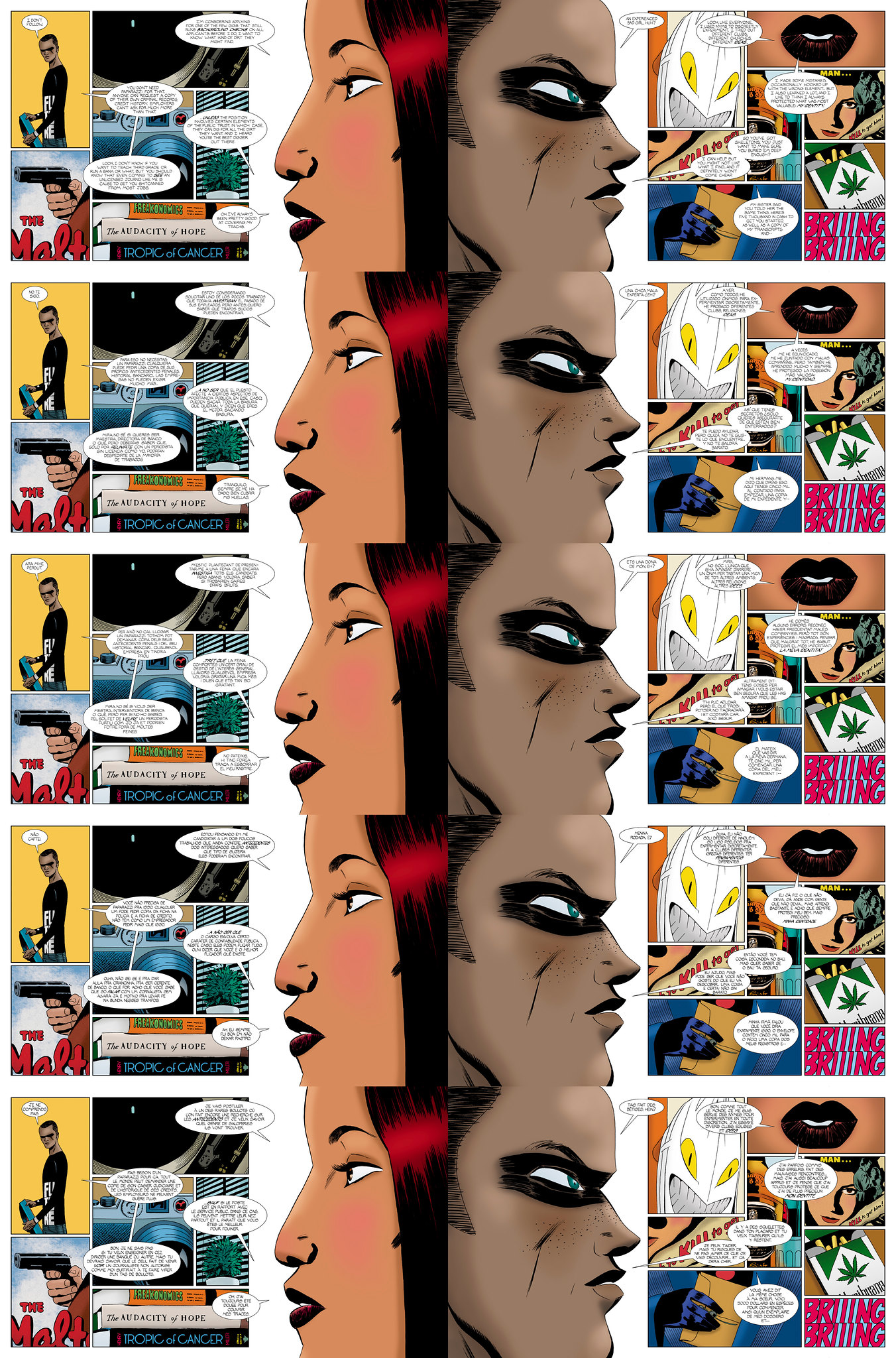
Private Eye #1, Pages 19 & 20, by Brian K. Vaughan & Marcos Martin (Panel Syndicate, 2013)
Languages (top to bottom): English, Spanish, Catalan, Portuguese, French
(Open the image in a new tab or click here for bigger.)
The idea to release The Private Eye online, DRM-Free and Pay-What-You-Want, was Marcos Martin's. He'd been looking to do something like that for some time and the opportunity that presented itself in Brian K. Vaughan's story was too good to pass up (especially in light of the storyline parallels about a specifically analog future without an internet). But Martin's true stroke of genius with The Private Eye's release format is in the multiple languages in which every issue has been and will be released.

Martin is a Spanish artist fluent in Spanish, English and Catalan, a romance language spoken in Southern Spain, France and Andorra. When Martin and Vaughan set up their novel distribution method, it was a small step for Martin to release the material in the three languages he was familiar with. And as each issue was released, additional languages would be added on, to date Portuguese and French with more in the pipeline. The nature of the work's production and release, both purely digital, makes this possible.

In most cases of translations of North American mainstream comics, there is a significant time and logistics lag involved. You first must find a publisher for the work in each market, dealing with the logistics of royalties and copyright. In many cases, even popular works by known creators may not see publication in foreign markets for years after initial North American publication, if at all. The availability in each market may be completely outside the creators' hands, with some publishers licensing out work without contractual obligation to pay royalties or even inform the creators involved. And this works both ways, with many well-received European (especially French and Italian) or Japanese comics never matriculating their way Stateside.

In The Private Eye's case, the work has already been released to every market on the globe with a computer attached, and it is a very simple matter to upload versions released under increasingly diverse languages. There are no printing costs involved and the only limit is the creators' will and the availability of quality translations. By their liberal and aggressive internationalization of The Private Eye coupled with their easy to access DRM-Free PWYW model, not only are Vaughan and Martin able to get access to the vibrant comic markets in North America, Spain, Italy, France and the United Kingdom, but they also have an immediate global reach not limited to countries with a comic tradition, a reach achieved by few creators in the history of comics. In the five languages The Private Eye has been released under so far, they can reach 1.2 billion potential native speakers (not even counting non-native speakers). Naturally the potential audience is much smaller than that, limited by access and desire as is any potential audience, but for the first time Vaughan and Martin have in an instant global audience. And by putting out the translations themselves as soon as possible, they negate the need for "scanlations" (fan translated digital bootlegs) ensuring quality control and added potential financial return.

It is this globalization of the type of quality material originally limited to North America that will change comics forever. The power of the tools Vaughan and Martin have at their disposal, coupled with their vision and will to utilize those tools, are truly remarkable.

Already the industry is shifting in response to Vaughan and Martin's vision: Image has announced that their titles will be DRM-Free, though not Pay-What-You-Want. But some established Image books, as well as every comic and graphic novel put out by America's largest publishers Marvel and DC, are locked into long-term republication and licensing contracts that necessitate large gaps in time and catalog coverage between different languages and regions. But it is a given that more creators with control over their rights to their work - a steadily increasing proportion in the light of the creator-owned renaissance gleefully endemic of this decade - will begin to internationalize their works like Vaughan and Martin have with The Private Eye, especially if they have digital global distribution at their disposal, even DRM limited distribution which most North American comics fall under.  


And of course, the comics medium exists as a unique visual language all its own where there is no translation necessary. But the costs of translation are minimal and the benefits are nearly endless. The Private Eye is the perfect work, with its quality and accessibility, to lead the vanguard of the new future of comics as a truly global phenomenon.

--
The Private Eye by Brian K. Vaughan and Marcos Martin is published monthly, DRM-Free and Pay-What-You-Wish in multiple languages by The Panel Syndicate at www.panelsyndicate.com

Tuesday, July 9, 2013

The Daring Visions of Grant Morrison and Garth Ennis

Dan Dare, Pilot of the Future by Fred Hampson
Exploring the Dan Dare Comics of Grant Morrison and Garth Ennis

There was a nice little Easter Egg of sorts in a recent issue of Jonathan Hickman's Avengers, as part of a series of one shots focusing on the origins of various updated or multiversally-transplanted characters joining a new, globally expanded Avengers lineup. One of these characters is the new "Smasher." A couple of years prior, college-age astronomy student Izzy finds a pair of space-goggles on her family farm in Iowa and through a small series of cosmic misadventures finds herself the first human admitted into the Shi'ar Imperial Guard. Upon returning to Earth, her elderly grandfather gives her the card of an old World War II buddy, Steve Rogers, encouraging her to join the Avengers. She is accepted and it is revealed that her full name is Isabella Dare; the card from her grandfather, signed Dan.

This is of course a sly reference to Dan Dare, the great 1950s British sci-fi comic book hero. Created by Frank Hampson for the seminal Eagle anthology magazine, Dan Dare, Pilot of the Future featured the titular Dare and associates in their space-bound adventures. It would be a bit reductive to call it England's Buck Rogers, but Dan Dare certainly shares in the legacy of male space action heroes that populated the popular imagination of the era on both sides of the Atlantic. Very, very British, Dan Dare shares as much of his legacy with the youth adventure books of the era focusing on pilots in the Second World War as with any contemporary science fiction work. The strip's early efforts by Hampson featured complex, long serialized storylines. Over time Hampson would be forced off the title and it floundered in the 1960s, seeing brief revivals in the 1970s in 2000 AD and a long, heavily retconned run in the revitalized Eagle in the 1980s, both pale shades of the creative and artistic heights achieved under Hampson's watch.

Dan Dare's adventures play an important role in the unique tradition and history of comics in England, although he has been largely absent in recent decades. Many of the important British writers and illustrators who contributed to the tidal wave of talent flowing into the U.S. from the U.K. in the 1980s were influenced heavily by Dare's pulpy, slightly anachronistic adventures. Indeed, an entire generation of Britons would fall under the influence of the strip's quintessentially British space heroics. Two such writers were Scottish scribe Grant Morrison and (to a different extent) the Northern Irish Garth Ennis, visionary creators with absolutely nothing in common, with the notable exception that each writer has helped produce startlingly original works based on Dan Dare. And unsurprisingly, each creator's work with the character reflects his own long-established, fiercely unique (and diamtrically opposed) aesthetic.

(It's important to point out here that both works utilize boldly reimagined versions of the established Dan Dare cast and setting. Perhaps "reimagined" isn't quite what Morrison and Ennis did as much rethought within the context of time passed. These are not ill-planned modernizations like the 1970s 2000 AD work, but sequels, dark mirrors of the glorious past, in each instance a new reality extrapolated into a future Dan Dare did not fight for, but achieved nonetheless. It is not any more necessary to have read the original 1950s comics to understand who's who and what's what any more than it is to have read the Silver Age to understand any modern superhero, or perhaps, to have read Astro Boy to understand Pluto.)

Dare by Morrison and Hughes

Dare, by Morrison and Hughes
(Fleetway, 1991/Fantagraphics, 1992)
The first of the two writers to tackle the legacy of Dan Dare was Grant Morrison, in concert with artist Rian Hughes in a story serialized in the short-lived 2000 AD spinoff Revolver in 1990. What Morrison and Hughes accomplish with Dare is frankly nothing short of astonishing, even more surprising that Dan Dare's rights-holders allowed Morrison carte blanche to tell a story as subversive and dark as he did. Not only are the themes presented a transparent satire of the destructive social policies of Margeret Thatcher in the UK in the late 1980s (as well as politics and media in general), but a fierce and stinging commentary on the tragedy that was the life of Dan Dare's creator Frank Hampson.

The Original Sin of American Comics was, of course, the purchase of Superman from Joe Siegel and Jerry Shuster for a pittance, and their subsequent mistreatment and rejection by the multibillion dollar company and industry their creation helped forge. This is referred to as the Original Sin, less for the Christian biblical parallels - Siegel and Shuster and their creative descendents aren't the ones living in perpetual sin for their actions, but the first victims of a particular strain of corporate greed that echoes down generations. It set a standard of a form of creative robbery that devalued the comic creator in a way not seen in other media, a trend that has only recently seen any kind of mitigation. For British Comics, with its unique trajectory rooted less in superhero comics and more in sci-fi comic anthology magazines, Frank Hampson's treatment by his employers at Eagle, though not as bad initially as Siegel and Shuster's treatment by National, still left Hampson penniless, suicidal, and eventually dead, an almost forgotten figure.

Morrison and Hughes' Dare reflects the tragedy of Frank Hampson in almost a roundabout way for much of the story, the tragedy's influence only being made crystal clear at the very end. But even absent the Hampson parallels, Dare is a brilliant work of postmodern science fiction. The story opens with Dan Dare, retired, living out his life in solitude on his estate, hobbled by age, plugging away at memoirs he will never finish. His past glories are long gone, the friendships from his past just another dusty memory. Jocelyn Peabody, his could-have-been paramour from his adventuring days is dead, by apparent suicide. His one-time best friend and right-hand man, Albert Digby, won't even look him in the eye at the funeral.

The Prime Minister, Gloria Monday, shows up, not to pay her respects but to recruit Dare. There's an election on, and Monday's Unity Party needs a symbol for the masses, an agreeable and positive representative to tip the balance. With few other options, Dare agrees to become a propaganda tool for the Unity party. He is indifferent to the politics, but this gives him a chance to relive past glories, and he needs the money. After doing some campaign work, Dare is approached by a mysterious agent of Digby's. She flies him to a secret location, touring the wasteland that has become England along the way. Things are rosy in the South, but the North continues to show the scars of Monday's destructive socioeconomic policies. The food lines last days, the free Treens - the alien species native to Venus who once were the subjects of the genius dictator The Mekon - live in retched ghettos, the past architecture of the future rotting away like a corpse in the sun. Digby is seeking out Dare because Peabody's death was no suicide - she knew too much, involved in a conspiracy that reaches all the way to the Prime Minister.

We learn the source of Digby's antipathy to Dare. After the fall of The Mekon, the Treens became subjects of Earth, Venus nothing more than a source of food for the increasingly starving and impoverished human population. The Treens rose up and the military, at the direction of the Unity Party, brutally puts down the rebellion, killing scores of innocent civilians in the process. And Dare was front and center of the atrocities, not that Digby is innocent either. It was war, and war can be unspeakably ugly. Digby convinces Dare to join him in finding out what Peabody knew, and the revelations force Dare's hand in taking action against Monday, herself just a tool of the returned Mekon.

Dare is reprinted in Rian Hughes' 
Yesterday's Tomorrows (Image, 2010)
The Mekon was Dare's greatest foe, one of the smartest beings in the solar system. And Mekon's machinations have proved fruitful. He's won, plain and simple, and on the surface there's not much Dare can do about it. The end, though, comes in fire, a complete wiping of the board, a mutually assured destruction, the final act of a desperate, broken man against an intractable enemy and against a future he helped create.

Rian Hughes' art in Dare is nothing short of revelatory. Hughes, one of the most distinctive visual voices in comics, could not have been a better choice for the project. Hughes' heavily designed and pop-fifties-infused style was the perfect visual commentary to match Morrison's postmodern narrative. In the original stories by Hampson, the visual (and narrative) aesthetic was one of gee-wiz sleek fifties-futurama projected into the future. Hughes' art reflects that, showing a future both anachronistically inhabiting the surface promise of that era and existing among the wreckage of the decaying past, the crumbling infrastructure a larger symbol of England's rotting soul.

Morrison is now someone who has a legacy of work that embraces the better angels of our nature, celebrates the possible and revels in genre. But Dare possibly represents Grant Morrison's most cynical work, both in the political commentary and his own views of Dan Dare's place in popular culture. In the effects on England and the costs of using Dan Dare as a tool of political war crime, his anger at Margaret Thatcher and her policies oozes out of the story, about as subtle as Urasawa's anger at George W. Bush in Pluto. Monday is willing to do anything for power, including making a deal with a genocidal dictator. And as part of her (and The Mekon's) plan, she utilizes Dare as a symbol to maintain power, a once honorable man corrupted completely. And Morrison's intent here just isn't Monday's use of Dare, but the continued use of Dan Dare as a property in the real world, an archaic symbol brought up and pranced around at the benefit of people who had no hand in creating him. The final powerful pages fade from nuclear-white to pull away and show a blank art board sitting on a table, pure MetaMorrison. The book closes with a quote, from Hampson himself: "Although I wished he would, Dan Dare refuses to lie down and die..." The message that Dare's exploitation is reprehensible. Naturally Morrison himself is a party to that continued travesty, if it is indeed such at all.

Dan Dare by Garth Ennis and Gary Erskine

Dan Dare by Ennis and Erskine
In 2007, Virgin Comics - a publishing concern predicated on putting out works by Indian creators with an eye on tapping into the largely underrepresented comic market in one of the world's largest countries - got the Dan Dare license and hired writer Garth Ennis and artist Gary Erskine to tackle it. An inspired creative decision from an odd choice of publisher, but the finished work is truly remarkable.

Now, I'm very familiar with both Grant Morrison and Garth Ennis's deep libraries, and it's hard to imagine two more diametrically opposed aesthetics. Morrison loves the superhero genre, Ennis abhors it. Ennis has a produced a large amount of straightforward historical dramas, Morrison revels in metafiction. Ennis is known for the sublime ridiculousness of his extremely dark humor, Morrison embraces the lighthearted ridiculousness of genre. Indeed, Ennis is not especially well known for his popular genre work - while he has worked within superhero universes in a few limited examples, those comics were hardly superhero books themselves, and his one notable superhero opus The Boys is especially marked by his dislike of that genre. Many of his other (non historical fiction) works may have some fantasy or science fiction element, but those elements are hardly the focus. That is why I was genuinely surprised to see Ennis tackling Dan Dare, a most unambiguous science fiction property. He notes in his excellent introduction - and there is no better writer of introductions or forwards remotely involved in comics today - that his frame of reference for Dan Dare is not rooted in nostalgia for the original works, and his goals with the project were decidedly distinct from what any other writer has attempted with the property. And what Ennis pulls off in his Dan Dare is nothing short of remarkable in a career built on consistently remarkable works.

The best works of Ennis's long career are his war comics, not just shoot-em-up genre fap but genuine character oriented historical dramas told with respect for the people and history of the time, and with just a tinge of his trademark black humor. Ennis is a student of history, and his war comics, packed with technical and historical detail with an eye on the sacrifice made by very real people, are singularly remarkable in the comics field. No-one else working in comics can pull of what he consistently does with his war comics. And his Dan Dare, more than anything else, is a war comic, told with the same level of attention to detail and respect for character that he brings to his historical fiction. To approach Ennis's Dan Dare like his historical dramas is not to reject its sci-fi adventure nature. Indeed, Ennis embraces the genre and utilizes the tropes of the genre while at the same time completely turning every single one of these tropes on their head.

Like Morrison's Dare, Ennis's Dan Dare opens with Dare in his retirement, living among artifacts of his past in complete solitude. The future that he fought for is not the future that he finds himself living in. The Mekon and his forces were exiled from the solar system and some modicum of peace was achieved on Earth, with Britain at the forefront of technological and military advancement. But War broke out on Earth - China and the United States are burned out husks following a brutal and, apparently complete nuclear war. What is left of Earth exists at the whim of Britain's technological and financial generosity. And the corruption of power worms its way to the top. Dare was approached by xenophobic elements in the British government to be the face of their party, and he rejected them, choosing to live in peace on an asteroid, completely separated from Earth.

Envoys from the Prime Minister approach Dare asking him to come back into service. It appears The Mekon's forces are re-entering the solar system and his services may be needed. Dare sees through the message to the core of what's happening, that he'll be used as a prop. But there is genuine need - as he is being pitched the temporary return to service, most of the British space forces are ambushed at the edge of the solar sytsem and completely routed by The Mekon's forces. Dare, above everything else, believes in Britain and Earth and will serve because that is his duty. He meets up with his old friend Digby, and gets into contact with his old paramour Peabody, who is now Home Secretary under the PM. Not dragging things out, Ennis rips the bandaid off the conspiracy quickly - Peabody finds out the Prime Minister is in league with The Mekon, and quickly acts to take control of the government. Things happen fast and furious and the action that ensues Earthside is a damn fine political drama. Back in space, after a setpiece that may as well be a treatise on military strategy, Dare takes control of what is left of the British space forces and sets out to confront The Mekon directly.

It is the pure Britishness of this Dan Dare that adds to this work's remarkability. Dan Dare's service is rooted in his grand belief in Britain above all else. He is an honorable man who will fight for his country over and over, regardless of the circumstance. There are many recurring themes in Ennis's war comics. One of them is the soldier's duty in contrast to the soldier's accomplishment. Often Ennis makes note that the end result of the soldier's sacrifice may not be what the soldier sought out to do, the future achieved not what the soldier fought for. Dan Dare is no different. Dare fought for Britain only to see them abdicate their responsibility in the aftermath of the U.S.-China nuclear war, taking advantage of the remnants of the world rather than taking leadership. But he fights now because this is his duty. As Peabody notes, "He saved us again and again, and what do we do? He blazed the trail and we paved it with excrement. But he'll fight for us now, because he loves this country more than life itself."

The sacrifices made in defense of country and planet are not taken lightly, the soldiers who die not base redshirts thrown into the cannons, but human lives lost in the line of duty. Dare, as commander of the forces, knows and acknowledges that the price of freedom is blood and every loss is felt. At one point a major character falls in battle, sacrificing himself to allow ships of civilians escape from The Mekon's forces. It is a heart-wrenching moment, seemingly representative of every such sacrifice made in the history of warfare. Ennis is someone with the uncanny ability to make war comics that don't glorify war and that don't preach. There is a larger message, of course, but it is not about the nature of war. It is, in essence, about embracing British exceptionalism, more specifically about rejecting the imperialistic exceptionalism that breeds greed at the expense of the third world and embracing the exceptionalism that says Britain is in a unique position to benefit the galaxy (world) through leadership and acts of goodness and inclusion.

And on top of all this, Ennis and Erskine's Dan Dare is a consistently exciting work of science fiction that plays with the expectations of genre and story.  This may be a future sci-fi story, but the uniforms of the military, the equipment they use, even the tactics of the ships in battle are all very recognizably modern, which is important. Where Hampson's work (and by extension, Hughes' art in Dare) was a projection of 1950s sensibilities into a gee wiz future, Erskine's art and Ennis's story is very much a projection of not just the now but the constants of military functionalism into an accessible futurescape. The result is a logical, accessible, entertaining. And storywise, no major or minor character is safe from the consequences of warfare. People die in war, that is the brutal reality of it. Just because Ennis spent seven issues setting up a character to have a genuine, transformative arc doesn't make them safe from the consequences of war. Everywhere where you think the story will zig, it zags. Built on a foundation of logic, it notes the silliness inherent in sci-fi, embraces it and then brushes it aside. We get a perfunctory technobabble explanation of The Mekon's grand weapon, which Dare simply brushes off. There is a mission on, and the nitty gritty details just get in the way. And unlike most science fiction of the 1950s, there is a very strong female presence in the characters of Peabody and Lt. Christian, a young officer vaulted into command because Dare sees the potential in her.

Where Morrison's Dare was cynical and a bit hamfisted in its political message, Ennis's Dan Dare is accessible, riveting, entertaining, subtle and hopeful. Both works fulfill the promise of science fiction to comment on society and humanity, becoming so much more than a human vs alien shoot-em-up (though Ennis's manages to have more than its share of that, too). And both works pay homage to the original works that so influenced a generation of readers while breaking free and telling their own unique stories, transcending and embracing genre in equal measure.

--
Dare by Morrison and Hughes was serialized in Revolver magazine in 1990 and 1991 and collected by Fleetway shortly after, and reprinted in the United States in 1992 as a mini-series by Fantagraphics as Dare: The Controversial Memoir of Dan Dare, Pilot of the Future. It is currently available collected in the indispensable Rian Hughes anthology Yesterday's Tomorrows, from Image. Dan Dare by Ennis and Erskine was serialized by Virgin comics before the company folded. Dynamite Entertainment bought the license and released the material in hardcover and softcover as Dan Dare: Omnibus Volume 1. The Frank Hampson material is sadly out of print.

Monday, June 3, 2013

Six Perfect Panels, One Perfect Comic

Last summer we at JHU Comic Books had a special Kids Comics Day. We gave away free comics, had games and activities, food, the works. It was a big success, and I personally always love when kids are in the store. Sometimes, as The King foretold, comics can break your heart, but seeing all the kids in the store then (and every time) just makes you feel good about comics... it can mend that inevitable break (until the next time, anyway).

As part of the festivities we had coloring pages for kids and adults to illustrate at their heart's content, as well as blank panel pages for kids to create short little six-panel strips. There were many comics and illustrations created that day, many wonderful expressions of creativity not bound by known color schemes or desire for conformity or even logic. But there was one stand-out six-panel comic, one creation that on reflection is nothing less than a perfect comic.
This is the comic, by a ten-ish year-old fellow named Nate (I don't know his last name, I only have this scan of the piece and the memory of its discovery). The first thing that jumps out is the beautiful simplicity of the piece. A (presumably) human figure, simply yet extremely effectively drawn in basic crayon, jumps into a toxic vat of some sort. But what is, at first blush a humorous trifle, a brief little illustration dashed off by a child on a lazy Saturday at the comic shop, is in actuality nothing short of a transcendent piece of interpretive graphic narrative that elegantly, simply and powerfully tells a number of stories while being a stunning example of the very mechanics at the heart of the language of comics.

If you sense hyperbole, be assured I am quite serious. Now, to be certain, Nate likely had no intention other than to tell a brief, funny story about someone falling into a toxic pit. But in doing so he reveals a deep, almost inherent understanding of how comics work as a visual storytelling medium - a telling example of the universality and accessibility of the language of comics. And even if it wasn't the artist's intent, the finished piece evokes multiple interpretations, something that can only be achieved by the graphic narrative.

The first and easiest interpretation is the figure - I'll call him The Blue Man - jumps in to the toxic vat on the final panel. But there is something immediately striking about how the author chose to tell this story. The tale - "The Blue Man jumps into the toxic vat" is something that can be done in two panels sequentially, or even in just a one panel gag-illustration. But the author chooses to stretch the events out across six panels. The effect is profound: assuming we are watching a single event, putting it across multiple panels stretches out the action, like a tragedy happening in slow motion. The author instinctively recognizes that the panel gutter can represent any time period, be it centuries or seconds, and he breaks down the action of a few seconds across many panels. If the intent is humor, the effect creates - upon multiple rereadings and replayings of the comic in the mind - a funny sequence easily replayed and broken down and replayed again. If the intent is tragedy, the prolonging of The Blue Man's ultimate fate into a slow-motion drama heightens the calamity, each panel another blow to The Blue Man, each panel a tease of redemption, each panel an illustration of Schrodinger's Cat in its box, only for the box to open in panel six with all quantum possibilities coalescing into one final end for The Blue Man.

But the character's fall may not be a fall at all. The comic's uniquely interpretive nature may represent a slow-motion drama of The Blue Man being flung into the toxic abyss. The overall structure of the piece makes it very clear that The Blue Man is on a platform (or maybe plank?) of some sort above the toxic vat, as revealed by the vat's sudden appearance in panel six. (Any number of things could have been happening to The Blue Man until the vat's appearance, an appearance which enhances both the tragedy and humor of the piece.) But The Blue Man's descent is rigid. Do the first three panels represent the character's deliberate, stiff fall over the edge, only to be hastened by his jumping in panel four? Or do the motion lines in panel four represent the character being flung from the platform by some unknown force down into his fate? No matter the interpretation of the first four panels, panel five is brilliantly framed: how best to minimalistically represent the character's fall then to have him hang, half out of frame, from the top of the panel, in obvious downward motion as evidenced by the speed lines flanking his figure. The empty space in the panel created by the framing brilliantly creates a sense of the unknown - the emptiness a representation of what could be. There is space between The Blue Man and his fate, a fate that could be anything, and ultimately is his doom as illustrated one panel later.

But is the toxic vat The Blue Man's doom? Or is it the end of the beginning of The Blue Man's story? Through any modern window, falling into a toxic vat is hardly a beneficial activity. But what about through the frame of reference of superhero comics' Silver Age? With Marvel Comics specifically, beyond the artistic and narrative innovations initiated by the House That Jack Built in the 1960s, there was Stan Lee's old stand-by origin of nuclear rays or toxic waste or some similar mechanism endowing some unassuming individual with fantastic powers. The Fantastic Four were created by Cosmic Rays beyond the shielding of the Earth's magnetosphere, The Hulk transformed from Bruce Banner after being exposed to a Gamma-Ray burst, Matt Murdock being given the extraordinary senses of Daredevil after being doused with toxic waste. That these things didn't kill all of them, as would actually happen, is part of superhero comics' gloriously ridiculous fantasy. Hardly an obscure element of a peculiar genre, these origin stories are, thanks to movies and television and products and the proliferation of the comics themselves, an ingrained part of American popular culture. The foundation of many aspects of the new American myth-space is in toxic accidents. The Blue Man's descent, be it intentional, accidental, or as a victim, is not an ending, but an origin in the modern-neoclassical sense. In six panels, Nate gives us a representation not just of this character's origin, but the origin of hundreds of the gods and monsters that populate so much of the contemporary popular American fictional sub-conscious.

And my final interpretation, just as possible though likely far outside the artist's intent - each panel is not representative of one figure falling through time. Indeed, each panel is a singular illustration of different characters in their commonly shared fall into apotheosis, the panel gutters not just the space between moments in time of a sequential event but moments in time separated by years or decades or entire universes. This isn't a single illustrative example of one commonly shared origin but an illustration of every origin of that type ever told. It is the Red Hood and it is Daredevil and it is The Blue Man, all separate, all at-once.

No matter the interpretation or whatever over-analysis I bring to the work, in the end it is a perfect illustration of the language of comics. Story through sequential art, distilled into six simple panels. Comics are intuitive and powerful as a force for telling a story. The human brain is hardwired to understand language, and comics are a unique pictorial language all their own. This piece illustrates the universality of the comics language.
 
But more than any of that, it is a brief little cartoon, dashed off by a child on a lazy Saturday at the comic shop. And that is pretty awesome.

Saturday, May 25, 2013

Building a Franchise: The End of Geoff Johns' Green Lantern

The 500th issue of Green Lantern, and Geoff Johns' last
This week's giant sized Green Lantern 20 saw the final issue written by Geoff Johns, the creator who revitalized the moribund Lantern franchise in what was the first step in his rise to the creative top of DC Comics. The book is that rare thing in superhero comics: an ending. You get the ultimate fates of multiple human and alien lanterns of all spectra, and some rather specific hints of what is to come some years down the line. Johns pulls this off by doing the issue from the future, in flashback. These elements really have that Whatever Happened to the Man of Tomorrow kind of feel to it, but you have to slog through the final chapter in Johns' latest Lantern crossover whatsit first.

Johns' run with the franchise is marked by the deft way he brought the greatest Green Lantern, Hal Jordan back, energizing one of DC's coolest concepts in a way that hasn't been done since the re-creation of the character at the dawn of the Silver Age. His run is also marked by neverending crossovers and tiny retcons in what ultimately transitioned the book from superhero work to expansive space opera. (Well, it's always been a space opera, just one where Jordan murders half the universe.) His introduction of the Sinestro Corps and the elevation of Sinestro to one of DC's best villains was the critical and popular turning point for many, including myself. I have never really been into the DC Universe in the way that I have been the Marvel Universe, but my first exposure to Johns' Green Lantern - the epic spacewar crossover The Sinestro Corps War - had me hooked. I read everything that came since Rebirth, and became a devoted monthly follower of the franchise, a DCU first for me. I'm a sucker for space sci-fi, and the Green Lantern books - like its contemporary, the criminally out of print Abnett & Lanning Guardians of the Galaxy in the Marvel Universe - told fun outer space action adventure tales largely removed from the shared universe it inhabited. Johns would introduce the full spectrum of heretofore unseen Lanterns as his Green Lantern books began to build their own distinct mythology.

But Johns would again and again go to a familiar formula of introducing a retcon which would trigger some massive crossover. Blackest Night, which focused on c-list DC characters coming back from the dead and a massive war of the various Lantern colors, was the largest of these, encompassing the entire DCU in the process. My frustrations with the quality of the story (it just wasn't very good, at all) as well as having to put up with yet another Event Series (this time in a shared setting I had no affinity for) pretty much put a nail in the coffin of my DCU reading. I was wary of the increasing complexity of Johns' space opera and of ceaseless crossovers. I love space operas, I really do, but Johns' tired formula just wasn't doing it for me.

Shortly enough, though, the editorially mandated last-second clusterfuck that was the DC New 52 happened, and with it the opportunity for me to try some new DCU books, including jumping back onto Green Lantern. For better or worse, like the Bat-family of books Green Lantern actually kept its prior continuity, and with it the ongoing space opera. There would be more tired crossovers, and I'd like to think Johns had some great design, but honestly it always felt like yet another yet another. The latest storyline, Wrath of the First Lantern was the yet-anotheriest (hey, it sold books, so why stop?) and hardly felt like the end of an influential and apparently distinguished run. But it is the final chapter by Johns and once we get past the requisite and frankly incomprehensible nuttiness made bearable by the usually amazing art of Doug Mahnke (and about a dozen others for good measure), we get the various unexpected endings.

Johns, April 2009
(At this point I was going to summarize the proceedings of Wrath of the First Lantern but I just realized I wasn't really paying attention and probably couldn't recount it even if I was. So here's a picture of Johns I took from the JHU signing/panel we ran a few years ago. He's kindof dreamy in that boyish never-takes-his-hat-off kind of way, and honestly, he's a really nice fella.)

The endings were somewhat refreshing. Johns clearly loves the characters. But naturally, the way superhero comics generally work, those endings are valid for as long as anyone decides not to change them, which won't be long. Next month gives us new creative teams across the board on all the Lantern books (five titles in a market that once couldn't sustain one, if anything the most obvious metric of Johns' success), and with the fresh voices a chance at doing something different. I have been saying for some time that I would really like a Green Lantern book where a Green Lantern went out and did Green Lantern stuff - explored deep space with funny looking aliens, defended the whole sector from any number of varied and high concept threats in nice short arcs, original voices, original ideas... but then I realized that that was a pipe dream and not representative of any previously established status quo. As far as anyone familiar with the character in recent years, including myself, a Green Lantern book where a Green Lantern goes out and does Green Lantern stuff is just what Johns has been giving us. I hardly expect much different going forth. DC has been shown a formula that has worked, so why break it? And with rare recent examples (almost entirely from Marvel), different doesn't necessarily sell as much as the same old shit. Superhero comics are entirely predicated on the same old shit. Like in all the shared universes from all the major publishers, their responsibility is maintaining an IP, not creating art, and its not exactly like Johns is being completely extricated from the franchise - he is the DC Chief Creative Officer, after all. 

So we get to the end of an era, one that saw an almost forgotten space hero elevated to the A-List complete with multiple merchandise lines (Collect all seven nine rings!) and a blockbuster movie. Sure the movie was a bomb, but it wouldn't have happened in the first place without Geoff Johns. There are many ways to thank someone, and in this issue DC goes to the odd step of spending page after page with canned congratulations from their various contracted talent and several others. It reads like employees thanking their boss for being a genius when he was only doing his job... which is exactly what that is, actually. He did it well, with help of course (stand up and take a bow, Peter Tomasi) but there was nothing revolutionary to it, certainly not to the level we see here (Johns even got a Hollywood party). When creators die they don't get this much praise in print. The best creative minds in comics that actually deserve such effusive praise can't even get a gig. This guy got an executive position, an exclusive contract, plus carte blanche to do as he pleased ultimately producing safe, pedestrian superhero work on a bunch of titles that sold very, very well for which he is well payed. Do we really need the fellatio?

Next month, new creators producing executive-mandated stories while committing unpaid rewrites to bend to every tiny last second editorial whim all in the vain hope that someday various underlings can be cajoled into thanking them for page after page. Or, a bold, original vision. Or maybe, just maybe, a Green Lantern book where Green Lantern goes out and does Green Lantern stuff.

Wednesday, May 15, 2013

Ultimate Spider-Man and The Obligations of Superheroism

Please note that there are spoilers below for last month's Ultimate Comics Spider-Man 22

Ultimate Spider-Man 23
Brian Michael Bendis's Ultimate Comics Spider-Man has consistently been one of my favorite ongoing superhero comics. I love the new character of Miles Morales and his supporting cast, the writing is some of Bendis's best stuff of recent years, and we've been spoiled by the wonderful art of Sarah Pichelli and David Marquez. And being that the book takes place in the Ultimate Universe, Bendis has more freedom to take chances and to play with the status quo. In recent issues Bendis has, through bold story turns - though through vastly different means, not entirely unlike Dan Slott in Superior Spider-Man - flipped the established paradigm of what makes (a) Spider-Man, and raises fascinating questions about the nature of superpowered vigilantism.

Stan Lee always laments that he never got to write the Great American Novel. Except that he did: The Amazing Spider-Man with Steve Ditko. In addition to being just a damn fine comic book, the Ditko-Lee Peter Parker/Spider-Man is probably the best known superhero globally (with Superman and Batman) and one of the best examples of the revolutions introduced by the Marvel Age of comics. Spidey's origin is in the very DNA of nearly every modern superhero story: teenager gets powers, uses them for fun and profit, could have stopped a random robber, robber kills uncle, decides to help people with his powers. That's the quick and dirty version, but what actually occurs is far more complex, as it would be several issues of Amazing Spider-Man and several months after Ben's death before Peter Parker becomes (what we now know as) a Superhero.

Miles Morales's path to Spider-Man is much different than Peter Parker's. After getting Spidey-like powers by similar mechanisms as Ultimate Peter Parker, young Miles Morales takes up the mantle of Spider-Man. As Peter Parker had just very publicly died, this is done as much in tribute to Parker with the eventual blessing of Parker's family and friends, and, disturbingly, elements within the fractured government including SHIELD and The Ultimates. I say disturbingly because Morales is just fourteen years old when he gets the Spider-powers - this is a young man who should be in school, not fighting crime on the streets and especially not acting as a paramilitary, a child soldier, fighting other superpowered beings. While there is argument among members of The Ultimates about the propriety of allowing Morales into their ranks, they eventually acquiesce. There was a Civil War on, and cannons need fodder.

Perhaps that is too harsh, but maybe we need to be harsh when approaching the stark reality of allowing children to fight alongside adults in adult conflicts. Batman's continuously unforgivable penchant of recruiting children to fight his battles being a prime example of this in the DC Universe. And then, why vigilantism? The idea of the superhero - dressing up in funny costumes and using fantastic powers to fight crime (and more frequently ne'er do wells in funny costumes with fantastic powers of their own) - is such an odd pursuit and a uniquely American genre of fiction. The why and how of superheroism has been explored to death by so many over the last 75 years, and what Bendis is doing in Ultimate Comics Spider-Man is by no means revolutionary. But it is raising some interesting questions about the internal logic and ethics of costumed crime-fighting.

Art by Sarah Pichelli
The tragedy of Peter Parker is instantaneous - in his very first appearance, his inaction leads to the death of a loved one. The specifics are a little different for Ultimate Peter Parker, and Ben dies too, though it takes a few issues. But the tragedy of Miles Morales - the death of a parental figure - takes twenty-two issues to happen, and has the opposite effect of Ben Parker's death. Last month, in a shocking twist, Miles's mom dies in his arms, the direct result of his role of Spider-Man. The Venom monster was targeting Miles's dad (a near lethal case of mistaken identity for his dad), and Miles's mother dies in the crossfire as the NYPD and Miles tries to stop Venom. Classic Uncle Ben dies because Spider-Man wasn't being a hero. Miles's mom dies because he was.

In today's new issue #23, there is a sudden and audacious time jump forward (and quite a long one for the sliding, decompressed timescale of superhero comics). It has been some time since the events of the previous issue, and Miles has put away the Spider-Man costume for good. His focus is on academics and girls and family, not on the vigilante ridiculousness that got his mom killed. His best friend and Spidey co-conspirator, Ganke, is still holding out hope for Spider-Man's return, and so, apparently is Jessica Drew, Spider-Woman. She pressures him into taking back Spider-Man, "How many people could you have saved [since you stopped]. You fall off a horse, you get back on." Miles demands Jessica respect his wishes, with Jessica responding with the well-worn Power and Responsibility guilt trip.

Jessica's actions, quite nearly demanding that Miles become Spider-Man again despite his losses, regardless of the amount of time that has passed, seems frankly unconscionable. The boy's mother died in his arms because of the Spider-Man, and you try to guilt him back into it? If anything, Miles is being responsible with his power. Responsible to his family and friends, as he notes, and I would argue responsible to himself. But in the Marvel Universe (both of them) there almost seems to be a societal expectation of costumed superheroism, despite the vociferous protests of civilian entities of various superpowered actions. In a world where so many people have so many varied superpowers, it's just plain what you do. A decade ago in Grant Morrison's New X-Men, Charles Xavier brilliantly breaks down the necessity of costumes for his X-Men as nothing more than what the American public expects from those with powers. In our reality, if powers even remotely like those in superhero comics existed, one would expect those with them to profit off them, and there would be frankly nothing wrong with it. Quite the opposite, in fact. Human beings at the peak of physical perfection are well-paid athletes and entertainers. The super-smart are entrepreneurs or cogs in multi-billion dollar corporate machines. Those who are selfless with their skills or time do so by effective volunteering. Not a single human being on Earth would make the mental leap between unique physical or mental attributes and costumed crime-fighting. (And those on this Earth who dress up and go out on "patrol" - the so-called "real superheroes" - are nothing more than ineffective fools.)

Art by David Marquez
As a reader sympathetic to the character, a character that Bendis and his artistic collaborators have made me care about, I actually kinda wish that Miles would remain Spidey-free, that he would finish school, go to college, maybe meet the right girl and have a rewarding life while playing a positive role in his community. He's smart, he has a solid foundation in his father and his schooling, and has a bright future ahead of him. But it is unrealistic to expect that Miles will remain a civilian. The book is called Ultimate Spider-Man, not Ultimate Miles Morales. The expectations of a society that almost demands vigilantism while decrying it in the same breath are also the expectations of the readership (like some weird metafictional quantum observer effect). And even if Miles doesn't want to be the superhero, his hand might be forced by basic virtue of living in a city where crazy superpowered shit happens every day.

Bendis has been writing one version or another of Ultimate Spider-Man for thirteen years. He clearly loves the gig and keeps it entertaining, downright enthralling. It's not the Great American Comic, but it is consistently one hell of a read. The new drama of the Ultimate Spider-Man is so deeply opposite of the usual Spider-Man dynamic, yet so perfect for a character called Spider-Man. He wants to do right by his family, his friends, and his community. He has the same troubles as any teenager, just heightened by his powers, powers that come into conflict with those desires.

This is a world of colorful powers in conflict, and to not be a party to the never-ending four-color war is almost anathema, taboo. As much as he wants to be left alone and to live his life away from the perils of supeheroics, the world demands otherwise, his own feelings be damned. Miles is a victim of his own powers, and ultimately of the society in which he lives.

Thursday, May 9, 2013

Urasawa's Craft and Pluto as a Fiercely Original Work: My Treatise Concluded

In my previous installments in this series, I looked at the individual volumes of Naoki Urasawa's transformative masterpiece Pluto. (Click here for my other reviews in the series.) Here in my eighth and final review (split into three parts), I look at the themes, story and art in the series as a whole. 

In the first part of my treatise, I examined The Role of Hatred, Redemption, and Evolution in Pluto. In the second part I looked at Humanity and the Role of Memory in Subjective Reality in Pluto and I also examined the Effects of War and Urasawa's commentary on the Iraq War and American Imperialism.

Here in the third and final part, I examine Urasawa's craft and Pluto's role as a fiercely original work. I also give an overview of my reviews of the individual volumes. 

Urasawa's craft

I cannot say enough about Urasawa's level of craftsmanship at work - Pluto is the vibrant and electric work of a master storyteller. His and Nagasaki's exposition throughout is masterful and unobtrusive, a difficult task in any science fiction work. He metes out details of Gesicht's past in a way that builds to an emotional crescendo, with the revelations in the end both expected and emotionally overwhelming. Urasawa's handling of everything from suspense-filled conversations and massive battles, emotion and action, is all pitch-perfect.

Urasawa's staging of even simple events utilize the comic medium in simple and very effective ways. In our first exposure to Gesicht, it appears he is talking on a cell phone, when we know that he was simply holding his hand to his ear while communicating with someone remotely. (Much can be said about robot communications throughout the work which really amounts to powerful, long-range telepathy.) In Gesicht and Helena's final conversation, it appears they are in the same room, but they are communicating remotely. This is not a cheap trick but a brilliant and obvious bit of storytelling utilizing the established confines of robot communication. The result is more poignant and powerful expression of their bond, and the events that subsequently occur are that much more tragic.

The future presented in the story has a unique flavor to it. Pluto takes place many decades, if not many centuries in Earth's future. Despite it's far flung nature and the presence of nearly human artificial intelligences, the world is recognizable. The fashions worn by the characters are those of this current day and age, the geopolitical scene an identifiable pastiche of known nations and thinly disguised analogues. The biggest difference is in the level of technology (largely represented in the robots of the story) and the densely packed and stratospheric cities. Urasawa presents a bold vision of the future that does not get bogged down in unnecessary detail. One of the many strength's of Brian K. Vaughan and Fiona Staples current ongoing series Saga, despite the broadly exotic fantasy/sci-fi setting, is that there are purely recognizable elements like current slang and technology like iPods and televisions and printed books. Why take creative energy to make fictionalizations, be it in name or design, of common things that serves only slow down the narrative? The focus of both Saga and Pluto is on the characters and their emotions and actions, not in sci-fi minutiae. The story of Pluto leaps forward, propelled by the characters, unencumbered by needless detail while still reveling in its fantastic elements.

And then there is the use of color in the art. In the work's initial publication, the first eight pages of each individual chapter were in color. In the collected editions this is limited to the first eight pages of each volume. Color throughout would not really work given Urasawa's very fine line, especially in his dense, almost photorealistic depictions of cities and towns. But there is selective use of color in the story, playing an important role. Very much like the limited use of color in Steven Spielberg's otherwise black-and-white film Schindler's List, the sparing, limited and laser-focused use of color in the body of Pluto is powerful and evocative. Both instances revolve around Sahad. When Uran finds Pluto, on the run from himself in a hijacked body seeking out the part of himself that was once Sahad, he scrawls impressionistic, abstract graffiti on a wall. It isn't until Uran brings him color to paint with that the intent of the image becomes obvious: Pluto paints a field of flowers (a recurring motif throughout the story). It is the part of himself that was Sahad reaching out through the tortured soul of Pluto, creating a moving work that is presented by Urasawa in full color in contrast to the black-and-white surroundings. This effect signals the significance of the painting, not just for the moment, but for the story. (Urasawa repeats this image with Darius in his cell.) The other moment comes when Gesicht learns of Sahad from the flower merchant in Amsterdam. The origin of the name Pluto is not in the God of the Underworld but in the tulip Sahad creates, a flower that destroys all life around it but perseveres for years even in the harsh environs of the Persian desert. The single red flower stands alone in the field, in the bell jar, and on the page, and its revelation is a moment of extreme import in the story, the significance signaled and added by the startling, bold rouge.

Pluto the adaptation, as a fiercely original work

The covers and promotional material for Pluto lists the work as by URASAWA x TEZUKA. This is a generous bit of crediting (and clever marketing) by Urasawa. In actuality, Pluto was written and produced by Naoki Urasawa with Takashi Nagasaki and illustrated by Naoki Urasawa based on Osamu Tezuka's original creations. And in actuality, it is a distinctly original work with its own identity, a reflection of Urasawa's vision.  

Pluto defines itself immediately as something more than just an Astro Boy story. The central character is not at first Astro Boy, but Inspector Gesicht, a detective for Europol who is investigating a series of murders committed against robots and humans linked to a recently concluded war in Iran. The murders are grisly crimes committed against beloved robots and renown human scientists alike, with connections all the way to the leadership of several global powers. Set against a backdrop both futuristic and completely recognizable, the story grows to encompass themes of loss, identity, vengeance, and the very core of the human condition. And the story takes place at an axis of profound societal transformation at the dawn of a new human species and where no less than the fate of the world hangs in the balance. The focus of "The Greatest Robot on Earth" storyline on which Pluto is based is apparently more on the robot-fight aspect of the story, while Pluto goes in far more and far deeper directions.

Urasawa apparently hits many similar story points to Tezuka's original, specifically the characters used and the deaths of the most advanced robots. I don't know, I haven't read it. And you don't need to, Pluto stands on its own. Its very easy to find analogues of what Urasawa accomplishes. You could easily look at any of the modern masterworks of the superhero genre as important and original takes on classic characters and concepts. Or perhaps Don Rosa's masterpiece, The Life and Times of Scooge McDuck, inhabiting and expanding on Carl Barks' own seminal works. But I think a better comparison is the Batman film-cycle of Christopher Nolan. In it, Nolan takes the core concepts that have been around for decades and crafts startlingly original works of art, mature pieces of deeply commentary science fiction wrapped in riveting, suspenseful action packed character dramas. Which is Pluto to a tee.

And the deciding factor of Pluto's originality, the core that brings forth all of the themes I outline above, is the character of Inspector Gesicht. Urasawa's Gesicht - German for "face," both the face of Urasawa's vision and the representative face of the newly evolving robot kind - is one of the best characters of the new graphic canon. So much more than just a determined and intelligent investigator, Gesicht is consistently portrayed with a sense of humanistic morality and genuine emotion. Gesicht's humanity far outshines the actual humans of the story (with the possible exception of Ochanomizu). He goes out of his way to save the damaged robot that would become his daughter, in one of the most touching and emotional sequences in the work. His murder of Haas, despite the wrongness of the act, is one of the most understandably human reactions in the story. And in his decision to not kill Pluto in defiance of his orders signals his redemption - the decision not only signals a sea-change in the potentiality of robot-kind, but saves Hoffman and shows that his morality, not willing to kill an innocent being, is intact. Urasawa's Gesicht, complex, contradictory, three dimensional, is one of the best characters in comics, his Maggie Chascarillo, his Morpheus, his Peter Parker. The emotional connection the reader makes to him is strong, his passing and aftermath a major blow. His closing moments in life - his redemption, the extraordinary staging of his last conversation with Helena, and the manner of his death - and the revelation in the final volume of the details behind the saving (and loss) of his daughter, are some of the most genuinely moving moments ever portrayed in comics.

I do not have a lot of experience reading manga. This is not an aversion on my part, just a dual matter of availability and finding that small fraction of "good." I have read some Tatsumi, tried some One Piece (it is, after all, the best-selling comic on the planet, but not one for me), and even some Tezuka, but my manga exposure is woefully thin, something I am slowly rectifying. I picked up Pluto on a whim - I was familiar with Urasawa's reputation, I liked the production design, and when flipping it open I was struck by the detail of Urasawa's art. Deciding to read it, the story hooked me completely by the point Gesicht informs Robby's widow of her death. In the end I was definitely shocked by how superb the overall story was, and on rereading struck by the sustained intensity of the masterpiece. It is a work that rewards rereading and the experience of absorbing this work is one of the most rewarding interactions with a work of fiction I have ever had. This is one of my all time favorite comics of any kind.

Pluto is a work that is required reading, and should be taught as one of the signature achievements of the medium, very different from but in the same critical league as the comic masterworks of Los Bros Hernandez, Chris Ware, Alan Moore, Jack Kirby, Yoshihiro Tatsumi, Warren Ellis, Jason Aaron, Grant Morrison, Neil Gaiman, Moebius, Carla Speed McNeill, Brian K. Vaughan, Kevin Huizenga, and Osamu Tezuka himself.

There's a lot going on in this work...

...clearly, and I've only just scratched the surface of all the extraordinary things Urasawa accomplishes here. Pluto is an intelligent and layered work that rewards multiple readings and stays with you long after you put it down.


Further Reading:
"Pluto and Doubling" by Craig Fischer, The Comics Journal October, 2011
"Pluto: Robots and Aesthetic Experience" by Peter Wilkins, The Comics Grid January, 2012